AI Governance Toolkit
Most companies already use dozens of AI systems, and most of them were bought, not built: features switched on in software they already pay for. Few can say what they use, who owns it, how risky it is or whether the controls are in place. This kit gives you a governance system that fits the risk: one register, four tiers, four checkpoints and 32 controls, with the policy, standards and board reporting around them, all filled in for a worked example.
$149 $75 one-time, no subscription
Excel, PowerPoint and Word files. Yours to use and adapt inside your organisation. Delivered by email at once; 14-day refund promise.
15 working files, not a slide pack to read
Every file is editable and comes with a worked example for one fictional company, so you start from something, not from a blank page. Workbooks calculate as you type.
 Excel
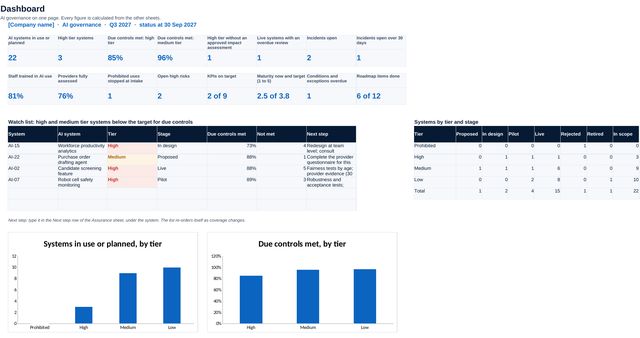
AI governance workbook
20 sheets that run AI governance: setup, the AI register, risk classification with prohibited and high-risk triggers and a factor score, the 32-control library, assurance system by system with coverage and a watch list, impact assessments, conditions and exceptions, provider assurance by use, incidents, risks, obligations, training, KPIs, maturity, roadmap, decision rights and the log. A dashboard pulls it together.
 PowerPoint
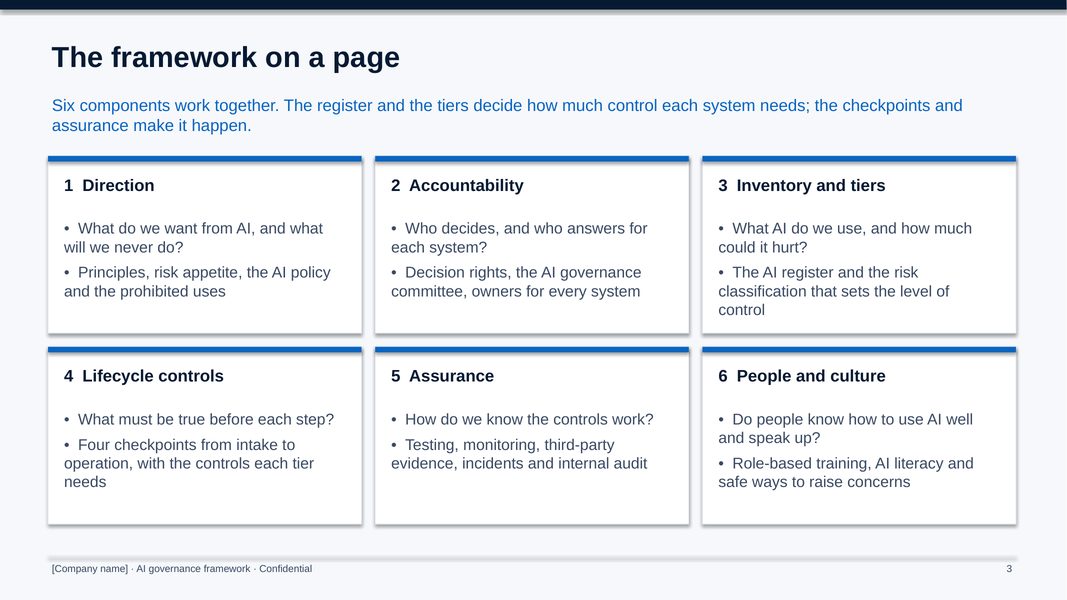
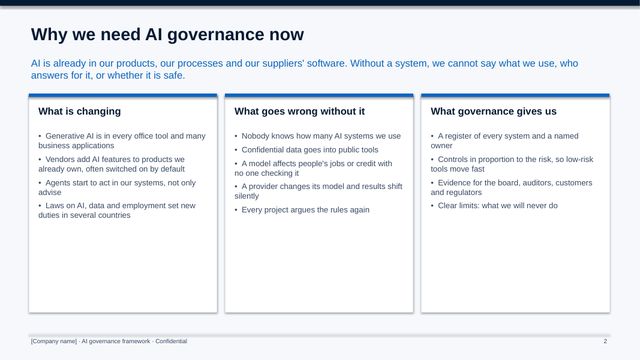
AI governance framework
14 slides to get the framework adopted: why now, the framework on a page, eight principles, four tiers, classification, four checkpoints, 32 controls, generative AI and agents, who decides, bought AI, the starting point and a twelve-month roadmap.
 PowerPoint
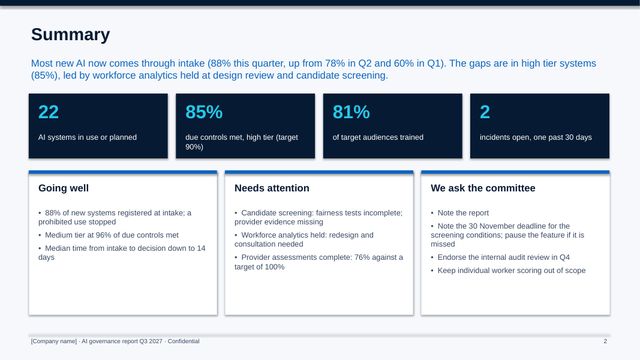
Quarterly AI governance report
11 slides for the board or executive committee, worked through: the register, control coverage, high tier systems, incidents, risks, measures, people and providers, maturity and decisions.
 Word
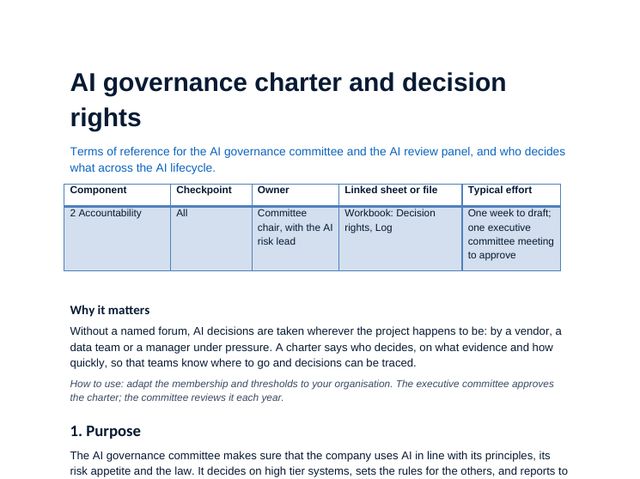
AI governance charter and decision rights
The forums, who sits on them, what each decides, and a decision rights matrix for twelve decisions.
 Word
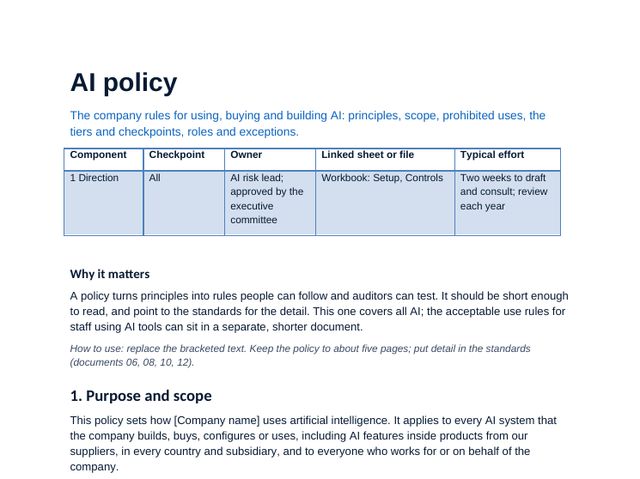
AI policy
Principles, risk appetite, scope, prohibited uses, the rules for every employee and how exceptions are handled.
 Word
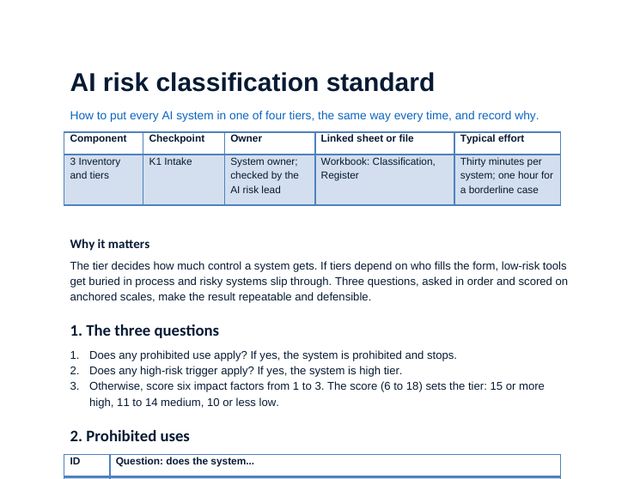
AI risk classification standard
Prohibited and high-risk triggers, six scored factors, four tiers and their review cycles, with examples.
 Word
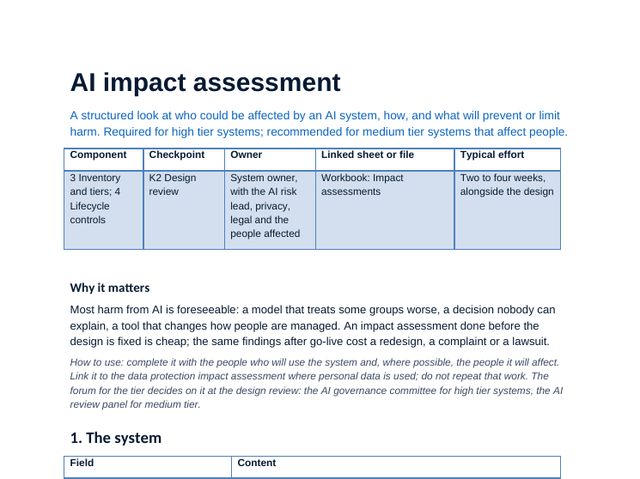
AI impact assessment
The assessment for high tier systems: purpose, people affected, data, fairness, oversight, risks and sign-off.
 Word
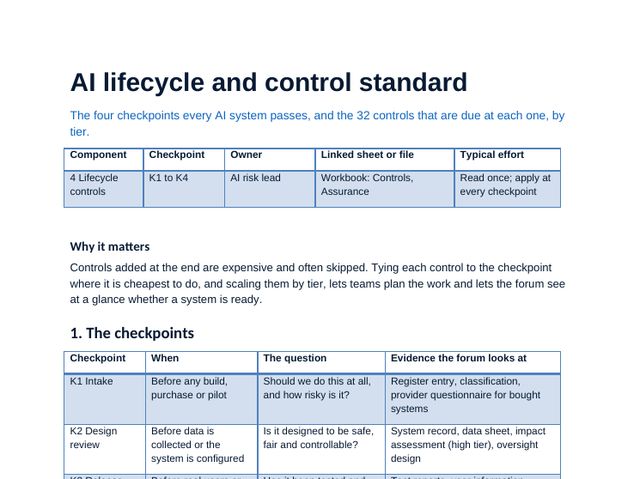
AI lifecycle and control standard
The four checkpoints and the 32 controls, which tier needs each one and the evidence it takes, mapped to NIST AI RMF functions and ISO/IEC 42001 Annex A topics.
 Word
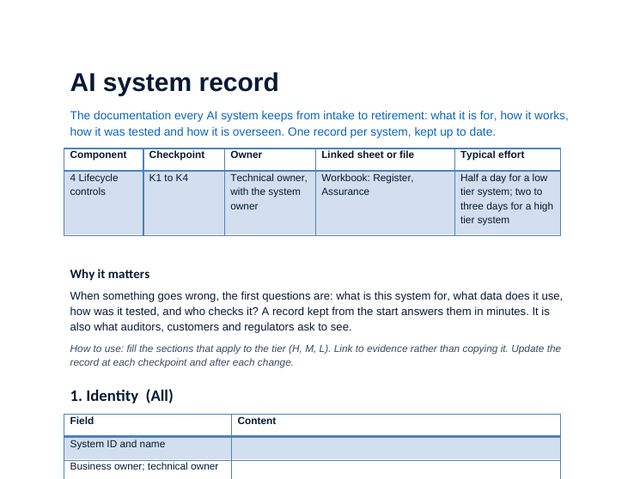
AI system record
The record every system keeps: owner, purpose, data, provider, tier, controls, monitoring and changes.
 Word
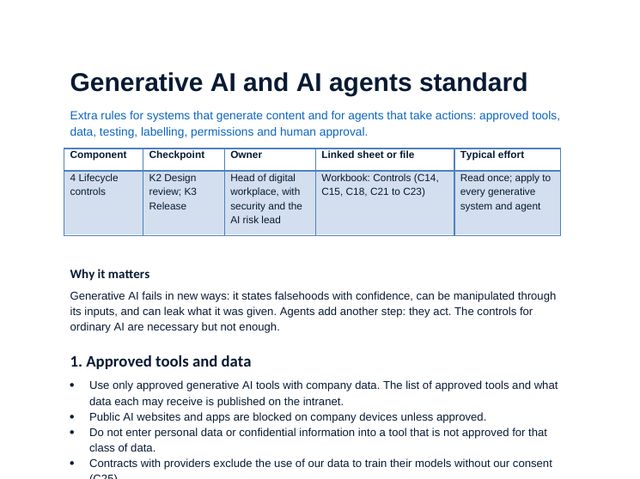
Generative AI and AI agents standard
Extra rules for generated content, prompts and data, and for agents that act: limits, permissions and human approval.
 Word
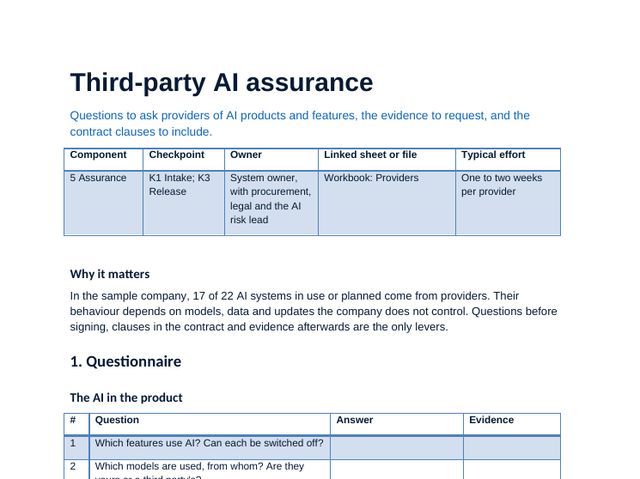
Third-party AI assurance
The questionnaire and contract clauses for AI you buy, and how to keep watching a provider after signature.
 Word
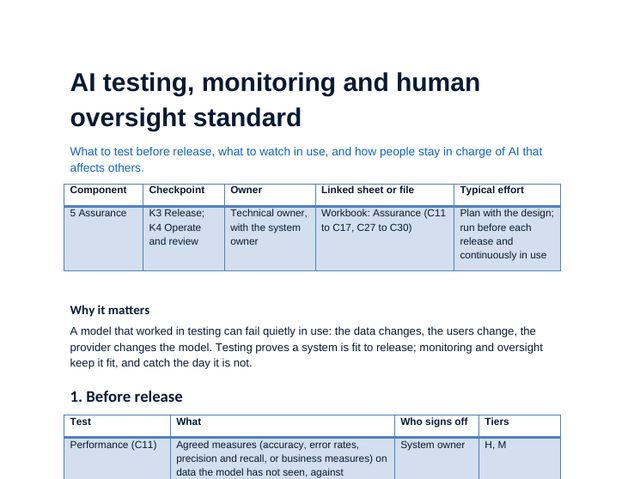
AI testing, monitoring and human oversight standard
What to test before release, what to monitor in operation, incident severity levels, and how people stay in charge.
 Word
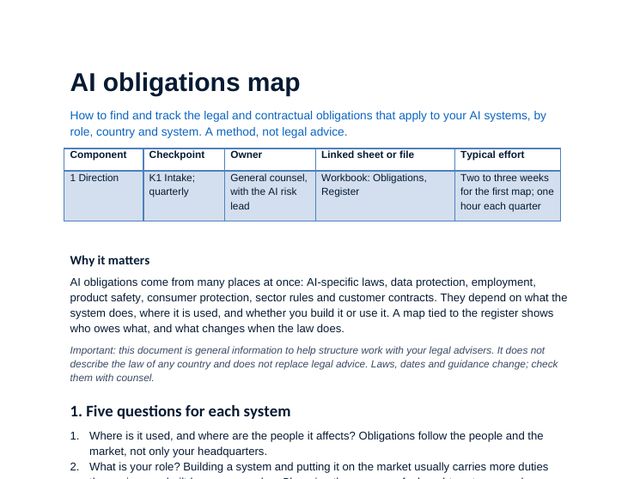
AI obligations map
How to map the laws, contracts and commitments that apply to your AI, with an owner for each.
 Word
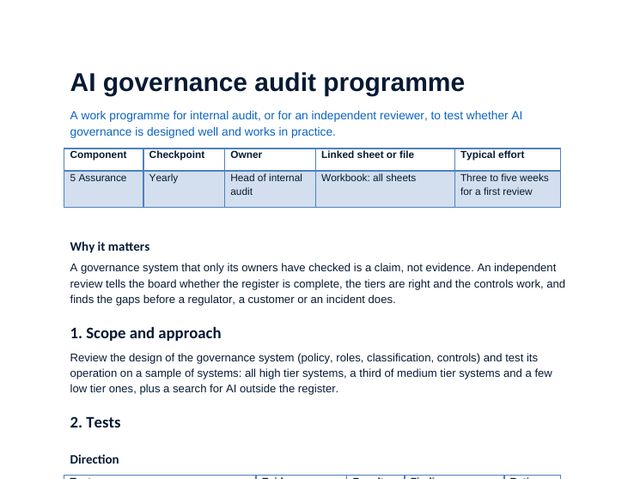
AI governance audit programme
Audit objectives and test steps for each component, for internal audit or a second line review.
 Guide
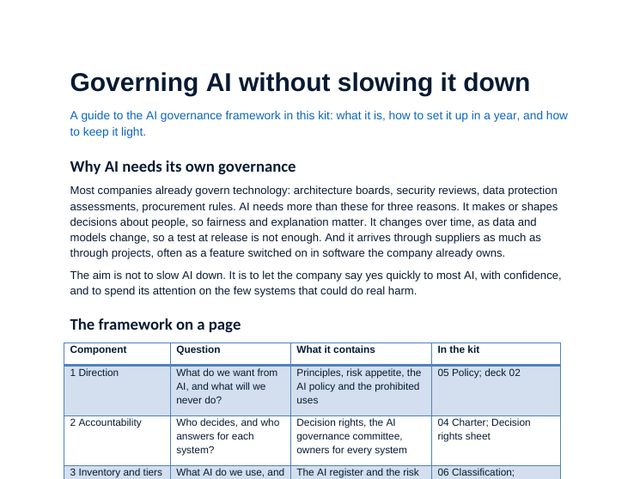
Governing AI without slowing it down
How to start, scale the controls to the risk, run the first quarter and avoid the common mistakes.
AI governance workbook, sheet by sheet
The workbook carries the method: scores, choices and plans calculate as you type, and the dashboard and deck figures come from it. Click any image to see it full size.
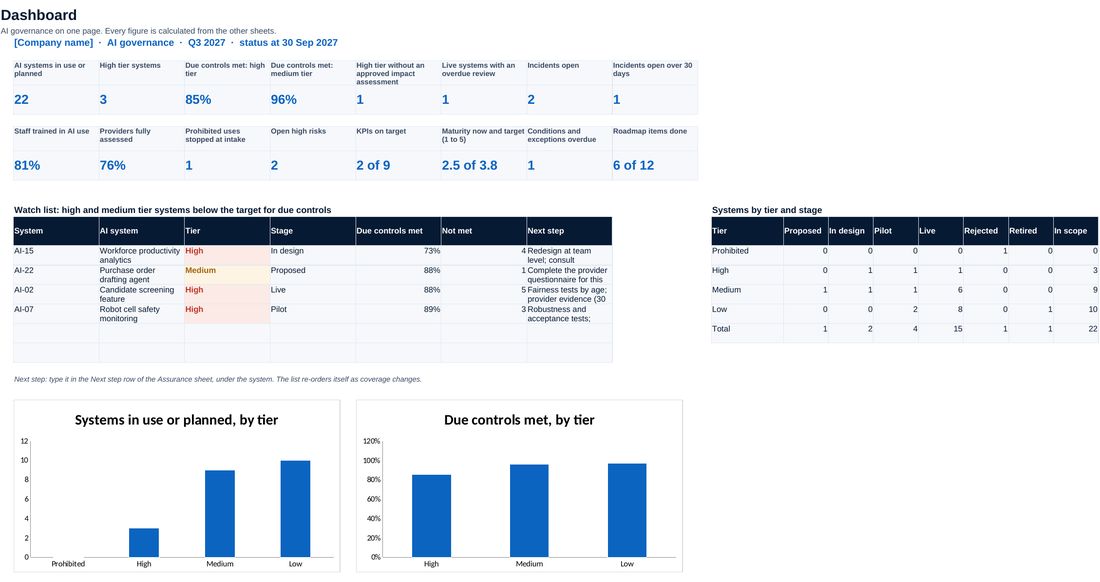
Systems by tier, control coverage, the watch list, reviews due, incidents, training and providers.
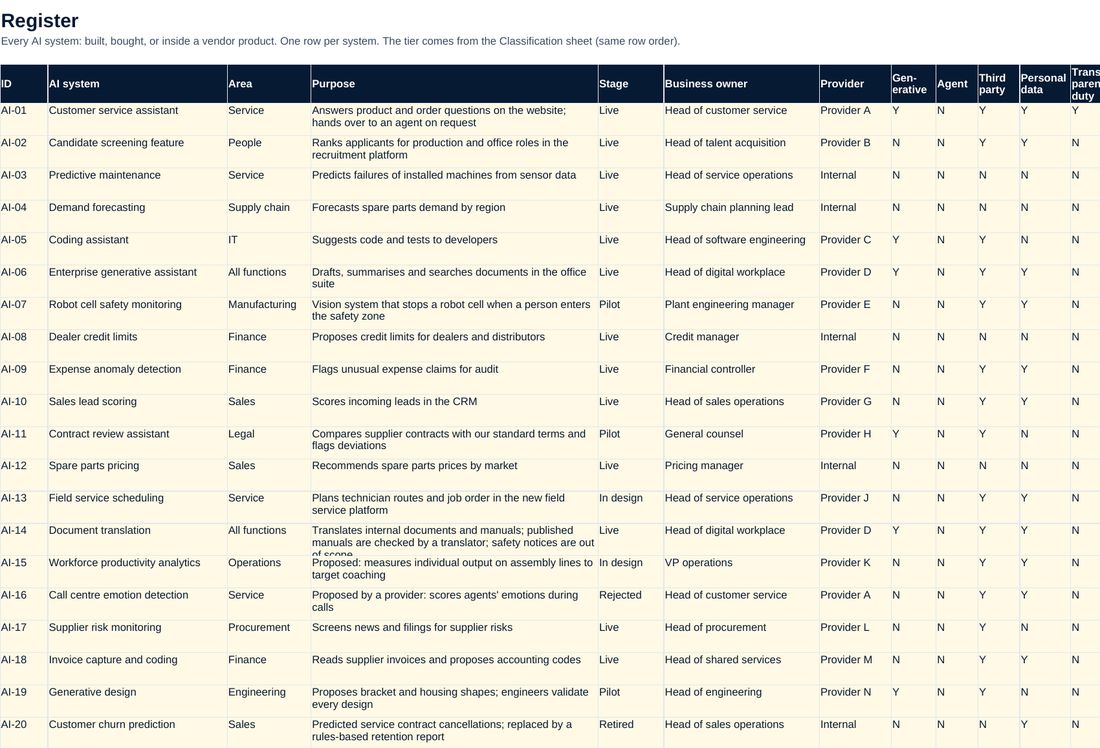
Every AI system with its owner, provider, stage, type and calculated tier and next review.
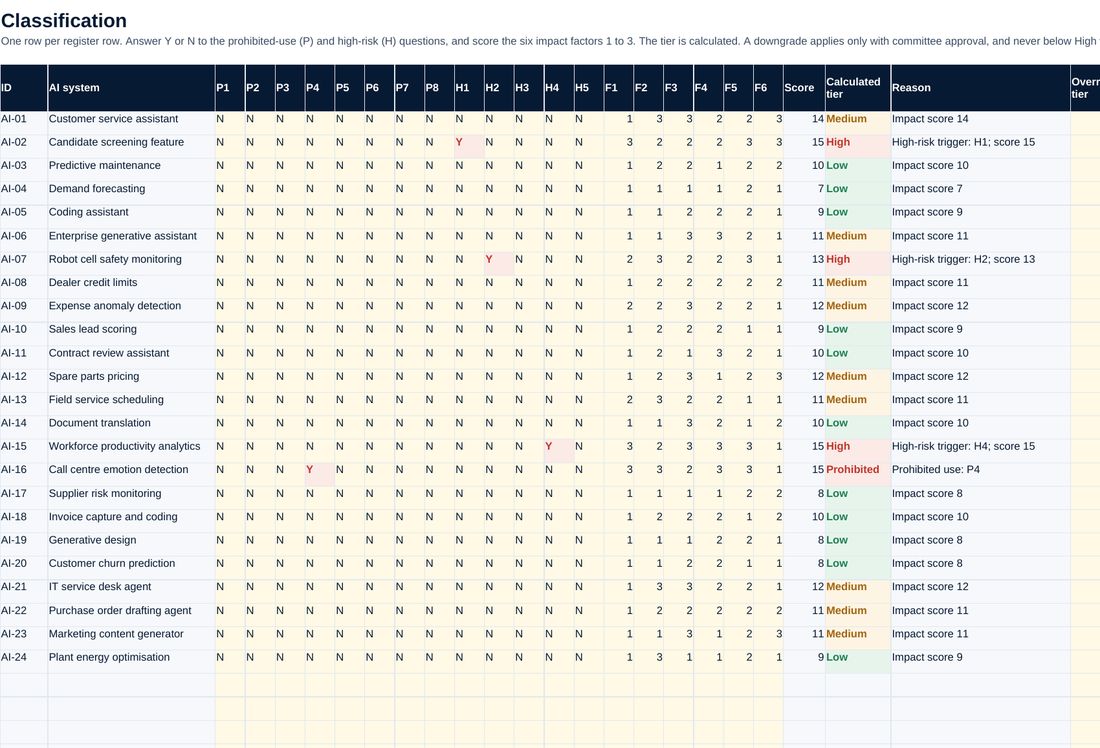
Prohibited and high-risk triggers and six scored factors that set each tier.
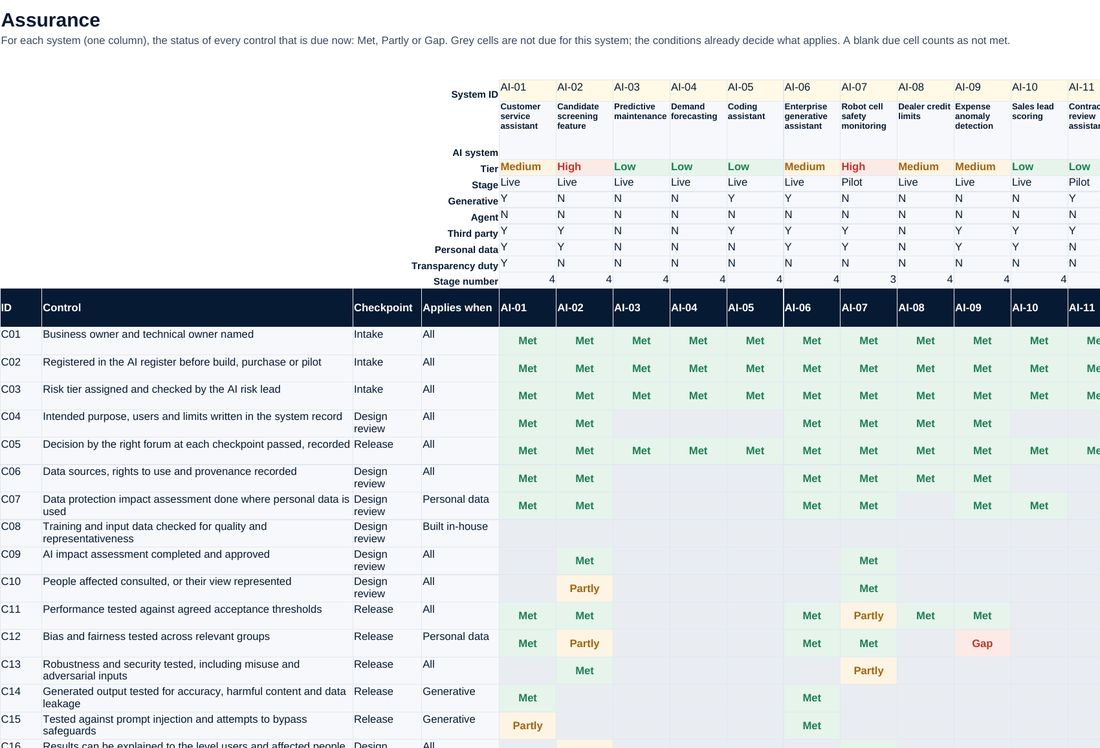
The controls due for each system, their status and coverage against the target.
Screenshots of the workbook with its sample data, opened in a spreadsheet application.
Control that follows the risk
Every AI system, bought or built, is in one register. Clear triggers and a factor score set its tier, and the tier decides which of the 32 controls apply and how often it is reviewed. Coverage is calculated system by system, so the board sees which systems fall short and why. In the sample, 24 systems become three high tier systems watched closely, and most low-risk tools pass with a light touch.
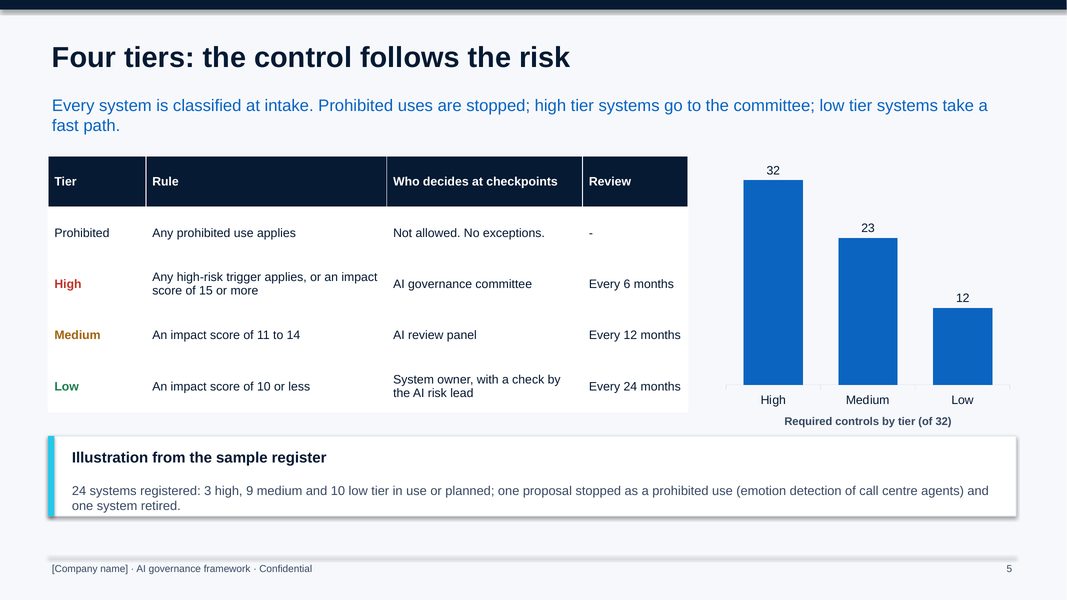
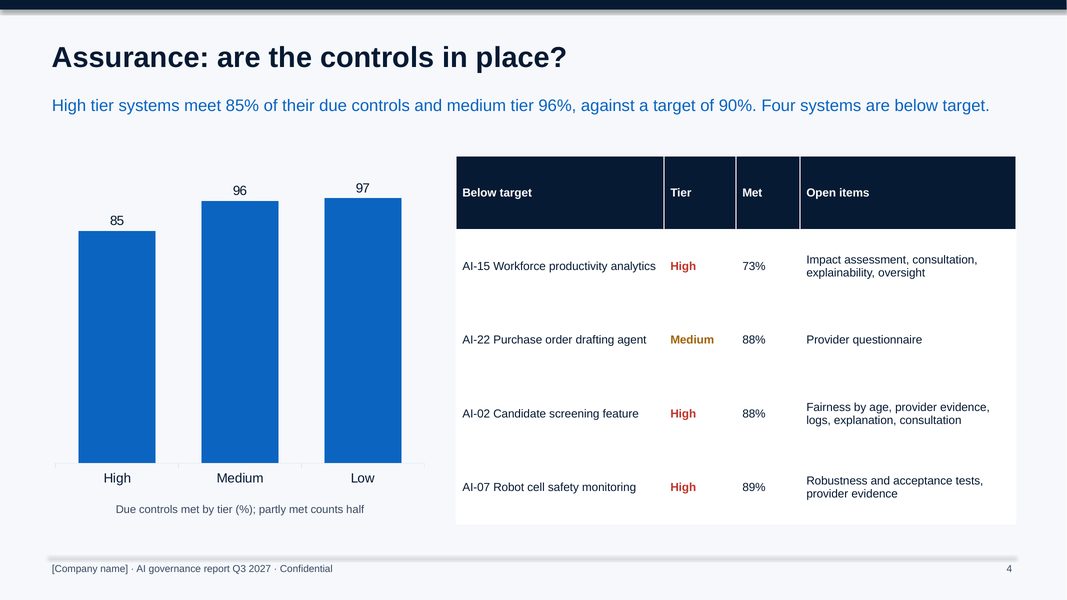
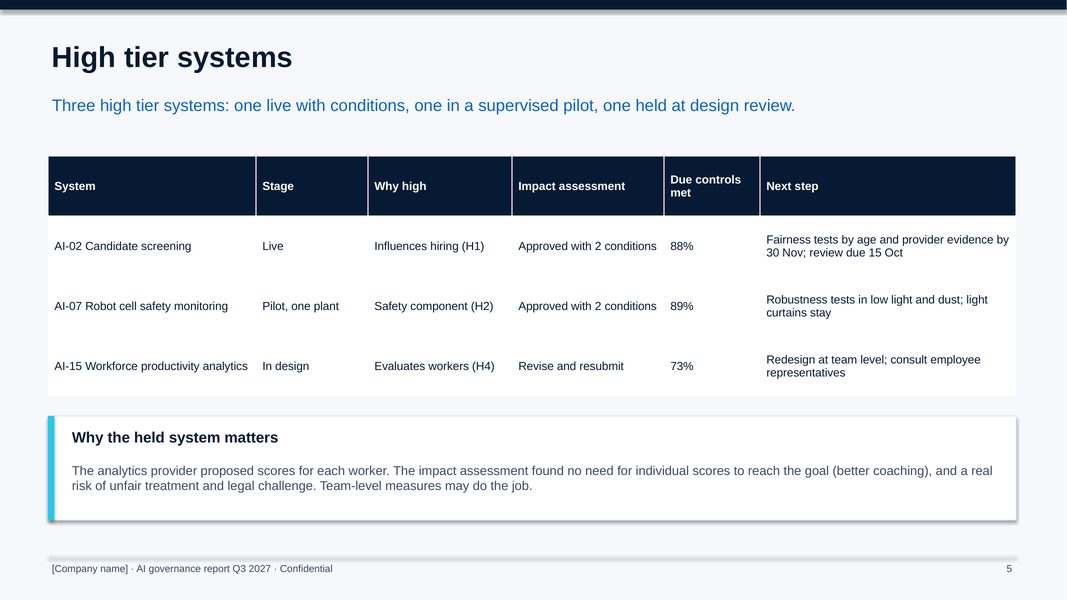
All figures shown are sample data.
The method, step by step
Name the owner and the forums, adopt the policy, and list every AI system in use, including features in software you already buy.
Classify each system, stop anything prohibited, and assess the high tier systems first.
Put the checkpoints into intake, design and release, close the control gaps and assure your providers.
Report coverage, incidents, risks and measures to the board, review systems on their cycle and raise the maturity.
Who it is for
- CIOs, CDOs and CTOs asked to show the board that AI is under control
- Risk, compliance, legal and privacy leads building an AI governance function
- Heads of data and AI who want clear rules that speed delivery up
- Advisers setting up AI governance for a client (one licence per client organisation)
What you need
Excel, PowerPoint and Word, or compatible software. A first version takes about three months; the quarterly cycle a few days.
Free guide on this topic
Questions about the kit
Does it make us compliant with the EU AI Act or ISO/IEC 42001?
No toolkit can do that on its own. The framework is built to be consistent with them and maps each control to NIST AI RMF functions and ISO management system themes, so it gives you a sound base. Confirm which obligations apply to you with your legal advisers.
We mostly buy AI rather than build it. Is it still relevant?
Yes, more so. The register, classification and controls cover AI inside the software you buy, and the third-party assurance document gives you the questions and contract clauses for providers.
Is it too heavy for a smaller company?
No. Low tier systems need 12 controls, mostly light ones. Start with the register, the policy and the classification, and add the rest as your use of AI grows.
Are the systems and providers in the example real?
No. The manufacturer, its 24 systems and Provider A to Q are fictional. Replace them with your own.
How do I get it?
Checkout is run by Creem, our reseller and merchant of record, which also handles tax and your invoice. As soon as the payment is confirmed we email you a private link to download the kit. Not what you expected? Ask within 14 days for a full refund.
Is it legal or financial advice?
No. The templates are practical starting points for management decisions. Have policies and contracts reviewed against the law that applies to your company.
Who can use it?
You and your colleagues, inside your own organisation. Advisers need one licence per client organisation. Please do not resell or republish it.