IT Roles and Skills Cards
53 roles and 41 skills on free play cards you can print, lay on a table and debate. One shared language for the people who plan, build, run and protect technology, and for the managers and HR partners who hire and grow them.
Free link sent to your inbox
Download the play cards (PDF, 0.7 MB)
One card per role, plus a key and a ways-to-play card. Free, for your whole team.
See all toolkits · See the 53 roles · IT Talent and Upskilling Kit · Free guide: IT team skills review
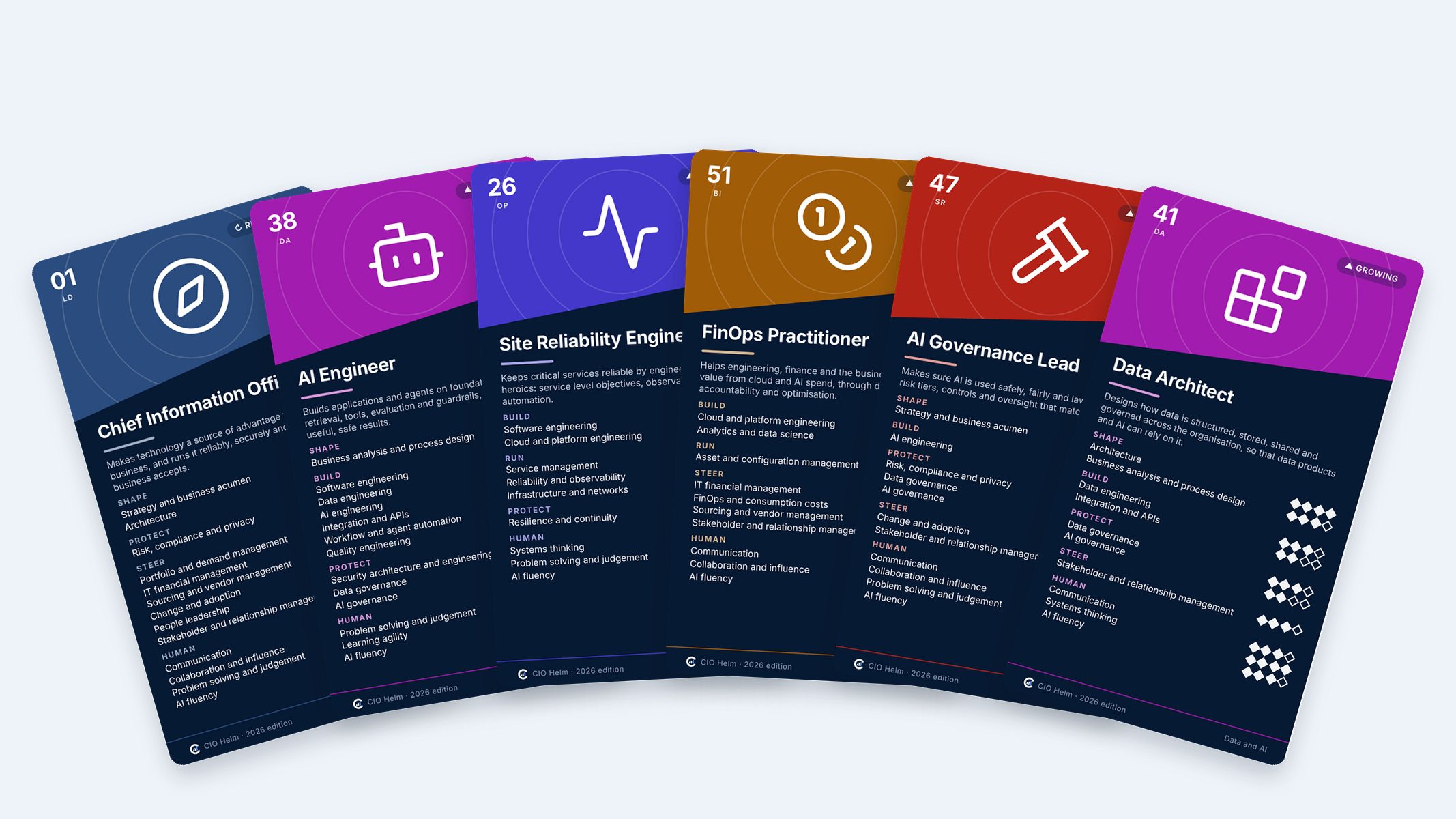
Built for every person in IT, not only the CIO
Our other kits help a leader decide and plan. This one is for the whole team: a common language for the roles you have, the roles you need, and the skills that connect them.
Made to be handled
Cards on a table start better conversations than a spreadsheet on a screen. People pick them up, move them, and argue about what a role really does.
Current for 2026
AI engineers, platform engineers, FinOps, AI governance, identity for machines and agents. Every card says how the role is changing, and every role carries AI fluency.
Free, and yours to share
Print them for every team. When you are ready to turn the conversation into a skills plan, the IT Talent and Upskilling Kit has the detailed deck, the workbook and a learning path for every role.
Seven families, 53 roles
Each role has a play card for the table: its family, mission, skills profile and outlook. The full profile of every role, with interview questions and career moves, is in the IT Talent and Upskilling Kit.
Leadership and strategy
Set direction, own the outcomes and speak for technology at the top table.
- 01Chief Information Officer
- 02Chief Technology Officer
- 03Chief Data and AI Officer
- 04Chief Information Security Officer
- 05IT Business Partner
- 06Enterprise Architect
Product and change
Decide what to build, deliver it and make sure people use it.
- 07Product Manager
- 08Product Owner
- 09Portfolio Manager
- 10Programme and Project Manager
- 11Delivery Lead
- 12Business Analyst
- 13UX and Service Designer
- 14Change and Adoption Lead
Engineering
Design and build the software, integrations and automations.
- 15Head of Applications
- 16Engineering Manager
- 17Solution Architect
- 18Software Engineer
- 19Quality Engineer
- 20Integration Engineer
- 21Enterprise Applications Specialist
- 22Automation and Low-code Developer
Cloud and operations
Run the platforms, networks, devices and services people depend on.
- 23Head of Infrastructure and Operations
- 24Platform Engineer
- 25Cloud Engineer
- 26Site Reliability Engineer
- 27Network Engineer
- 28Digital Workplace Engineer
- 29Service Desk Analyst
- 30IT Service Manager
- 31OT Systems Engineer
- 32Infrastructure Engineer
Data and AI
Turn data into decisions and build AI that can be trusted.
- 33Data Engineer
- 34Analytics Engineer
- 35Data and BI Analyst
- 36Data Scientist
- 37Machine Learning Engineer
- 38AI Engineer
- 39Data Governance Lead
- 40AI Product Manager
- 41Data Architect
Security and risk
Protect the organisation and keep it compliant and recoverable.
- 42Security Architect
- 43Security Engineer
- 44Security Operations Analyst
- 45Identity and Access Engineer
- 46GRC Lead
- 47AI Governance Lead
- 48Technology Resilience Manager
- 49Security Tester
Business of IT
Manage the money, the suppliers and the assets of technology.
- 50IT Finance Lead
- 51FinOps Practitioner
- 52Vendor and Contract Manager
- 53IT Asset Manager
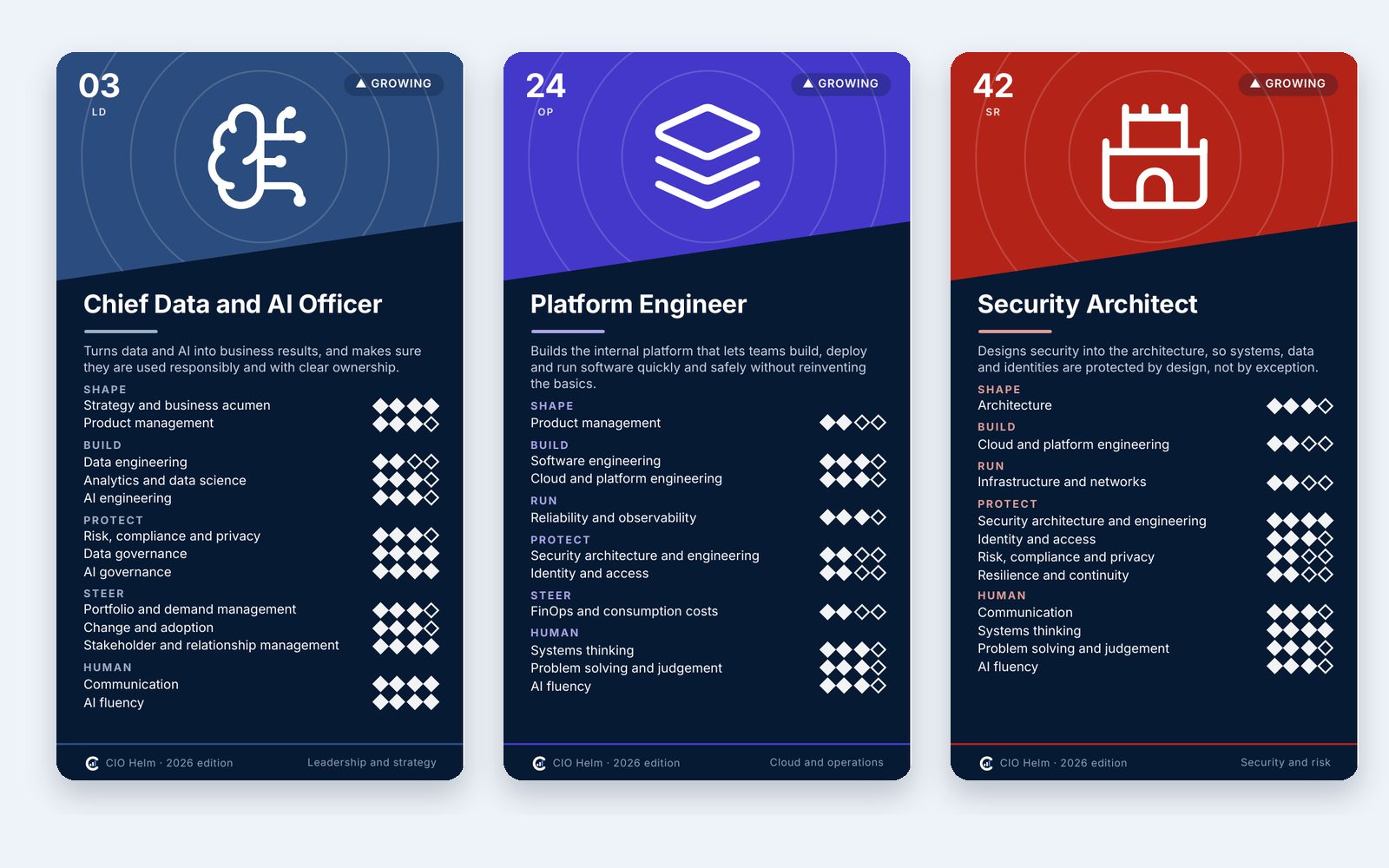
One card per role, made to be dealt
A bold, single-sided card for every role: its family colour, a symbol, the mission and the skills profile in diamonds. One card per page, ready to print on card stock or send to a print shop.
- Design the team: lay out the roles you have and the ones you need
- Who does what: deal a project and pick the cards it needs
- My next move: compare the diamonds of two cards
- AI reshuffle: sort by outlook and plan the Reshaping roles
41 skills in six families, four levels
The same scale for every skill, so profiles compare across roles and people can see what the next level means.
Understands what it is, why it matters and when to call in someone stronger.
Does the work independently on normal cases and knows the standard methods.
Handles complex or new cases, improves the method and coaches others.
Sets the direction and the standard for the organisation; others come to them.
Strategy and business acumen · Architecture · Product management · Business analysis and process design · Experience and service design · Technology scouting
Software engineering · Cloud and platform engineering · Data engineering · Analytics and data science · AI engineering · Integration and APIs · Workflow and agent automation · Quality engineering · Enterprise application platforms
Service management · Reliability and observability · Infrastructure and networks · Digital workplace · Asset and configuration management
Security architecture and engineering · Security operations · Identity and access · Risk, compliance and privacy · Resilience and continuity · Data governance · AI governance
Delivery management · Portfolio and demand management · IT financial management · FinOps and consumption costs · Sourcing and vendor management · Change and adoption · People leadership · Stakeholder and relationship management
Communication · Collaboration and influence · Systems thinking · Problem solving and judgement · Learning agility · AI fluency
Six shifts behind this edition
Many role catalogues still describe the IT department of ten years ago. These are the changes the deck is built around.
AI in every role
Every card now carries AI fluency. The question is no longer who works on AI, but how each role works with it.
From projects to products
More of IT is organised around long-lived products and platforms with owners and outcomes.
Platforms over tickets
Engineering and operations build self-service platforms instead of handling requests one by one.
Agents need guardrails
AI agents act across systems. Identity, integration, evaluation and oversight skills rise in value.
Security and resilience everywhere
Regulators and boards expect proof that services are secure and recoverable, including at suppliers.
Every cost visible
Usage-based cloud and AI pricing makes cost a design choice, and FinOps a shared skill.
Four conversations the cards make easier
Lay out the cards for the roles you have. Add the ones you will need in two years. Spot the gaps and the overlaps.
IT leadership team, HR partner · 90 min
Pick the card, adjust the levels to your context, and use the interview questions and "what great looks like" in the panel.
Hiring manager and panel · 60 min
Ask each person to choose the card they hold and the one they want next. Compare the profiles and agree two skills to grow.
Manager and team member · 45 min
Sort the cards by outlook. For each "Reshaping" role, agree what the AI takes over and which skills people need instead.
IT leaders, team leads, HR · 90 min
Who it is for
- CIOs and IT leaders shaping the organisation for the next three years
- Managers who hire, coach and plan careers in IT
- HR business partners and talent teams who support IT
- IT professionals mapping their own next move
- Advisers running an organisation or skills review (a separate download for each client)
What you need
A printer and card stock, or a print shop. A first team workshop takes 90 minutes.
Turn the cards into a skills plan
The IT Talent and Upskilling Kit has everything to act on the cards: the detailed deck with the full profile of each of the 53 roles, a team skills workbook that shows gaps and single points of failure, editable profiles, a learning path for every role, and a ready IT upskilling plan. Same roles, skills and levels.
Questions about the cards
Who are the cards for?
Everyone who works in or with IT: leaders designing their organisation, managers hiring and coaching, HR partners building career paths, and professionals planning their next move. They work best in a workshop with a mix of all four.
Are these the right roles for my organisation?
They describe a typical mid-size to large IT function in 2026. A smaller team will have one person holding several cards; a larger one will split some cards further. The editable profiles and the role template are in the IT Talent and Upskilling Kit.
How do I print them?
Print the PDF, one card per page, on card stock or at a print shop, and cut along the card edges.
What does the IT Talent and Upskilling Kit add?
Everything to act on the cards: the detailed deck with the full profile of every role, a team skills workbook with gaps and coverage, editable role profiles, a skills dictionary, a workshop guide, a learning path for each role and a ready IT upskilling plan.
How does it relate to SFIA or the e-Competence Framework?
It is an original, deliberately compact framework written for everyday use by IT leaders and teams. If your HR function uses a public framework, you can map the skills to it.
Is the outlook on each card a forecast?
No. Growing, Stable or Reshaping is the judgement of experienced CIOs about where each role is heading, not the result of a survey. Use it to start the conversation in your own context.
Can I use the levels for performance ratings or pay?
We advise against it. The levels are for development and planning. Agree them in a conversation with evidence, and never use them to rank people.
Is it really free?
Yes, and it stays free. Download it, print it and adapt it inside your organisation. Please do not resell or republish it; send colleagues to this page instead.
Who can use it?
You and your colleagues, inside your own organisation. Advisers need one licence per client organisation. Please do not resell or republish it.