Decide, build and run a global capability centre
Few executives have set up a GCC before, and most of what is published is written by the firms that want to build it for you. These tools are written by people who have built and run offshore centres: a free cost model to compare outsourcing, build-operate-transfer and a captive centre, the operating models explained, and the working files to take a centre from the board decision to a team that owns real work.
Excel, PowerPoint and Word. Rate cards for Bengaluru, Hyderabad, Pune, Chennai, Metro Manila and Cebu, dated and editable.
GCC Cost Model: captive vs BOT vs outsource
Price four ways to source the same work over five years: outsource to a provider, build-operate-transfer with a partner, a captive centre, or a hybrid. Your workstreams and role mix, six cities with low, mid and high rates you can override, the ramp, the parallel run, attrition, the retained team, partner fees and the people who leave onshore. Out come the five-year cost, savings, NPV, payback, cost per FTE by city and a sensitivity tornado, with a summary deck.
220 FTE of work, four options, one answer
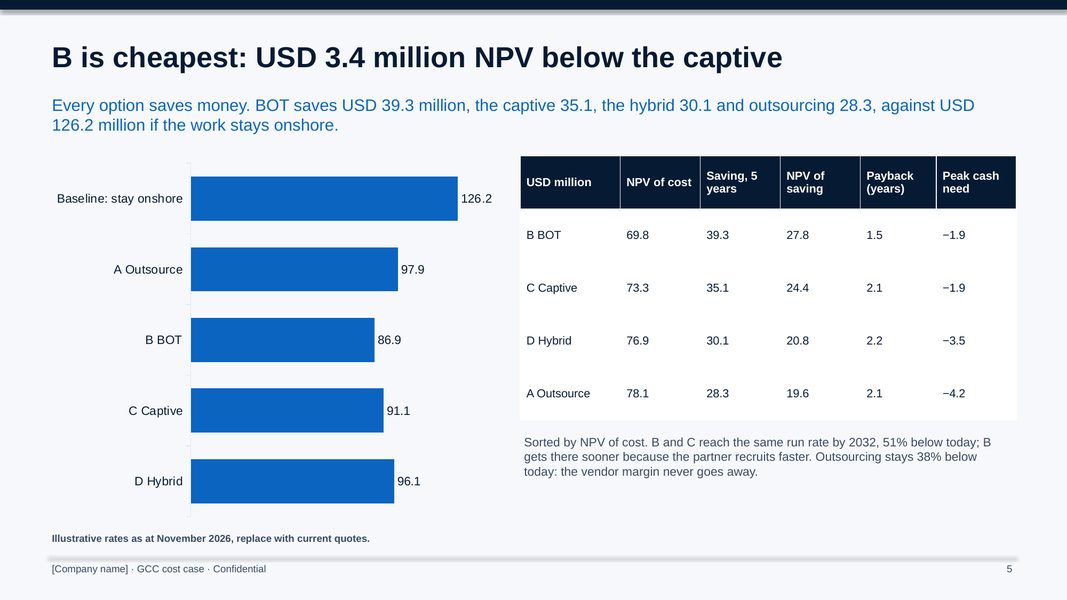
A fictional manufacturer with headquarters in Western Europe moves six workstreams, from ERP support and software engineering to the service desk and finance operations. Doing nothing costs USD 126.2 million over five years.
| Option | 5-year saving | Payback | Run-rate saving in year 5 |
|---|---|---|---|
| Outsource to a managed service provider | USD 28.3m | 2.1 years | 38% |
| Build, operate, transfer: Pune hub, Manila spoke | USD 39.3m | 1.5 years | 51% |
| Captive centre built in-house | USD 35.1m | 2.1 years | 51% |
| Hybrid: own the core, buy the run | USD 30.1m | 2.2 years | 43% |
Illustrative figures for a fictional company, rates as at November 2026. Read how the comparison is built.
Six ways to run a centre
| Model | In one line | Choose it when |
|---|---|---|
| Captive | Your entity, your leaders, your people from day one. | You know the country and the scope is large and long-term. |
| Build, operate, transfer | A partner builds and runs the centre, then hands it over at a price fixed upfront. | You want ownership in the end and speed now. |
| Managed centre | A provider runs a dedicated team under its own employment. | The work is stable and you do not need to own the people. |
| GCC-as-a-service | Ready-made seats, payroll, HR and compliance; you lead the team. | You start small and are not ready for an entity. |
| Hybrid | Own the core, buy the run. | Part of the work differentiates you and part is commodity. |
| Joint centre of excellence | A shared unit with a provider, sometimes with shared risk and reward. | You need skills neither side has alone. |
Whatever the model, centres that last move through four stages: from a delivery centre executing tasks, to a capability centre owning services end to end, to a portfolio owner with products, global processes and centres of excellence, to a transformation hub leading group-wide change. Read the operating models guide.
India and the Philippines, side by side
| City | Captive cost per FTE | Best known for |
|---|---|---|
| Bengaluru | USD 41,600 | Deepest engineering, product and AI talent; highest pay and attrition |
| Hyderabad | USD 39,500 | Large technology pool, strong for data and cloud |
| Pune | USD 37,700 | Engineering and manufacturing software, ERP |
| Chennai | USD 37,300 | Engineering, automotive, finance and operations at scale |
| Metro Manila | USD 32,800 | Service desk, finance and business operations, customer-facing work |
| Cebu | USD 28,300 | Operations and support at lower cost, a smaller senior bench |
Fully loaded annual cost for a typical technology and operations mix, year 1, mid scenario. Illustrative rates as at November 2026: replace them with current quotes before you decide.
The GCC kits
From the board decision to a running centre, and the partner to build it with.
GCC Cost Model
Price outsourcing, build-operate-transfer, a captive centre and a hybrid over five years, in six cities in India and the Philippines: savings, NPV, payback and a sensitivity tornado.
1 workbook1 deck2 documents
GCC Setup Kit
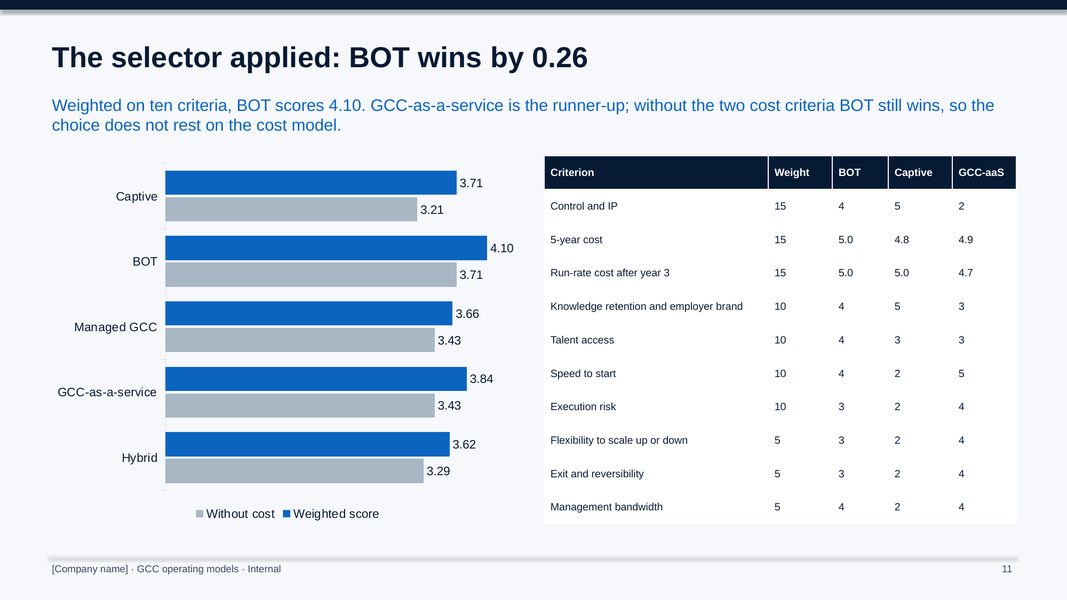
From the board decision to a running centre: the operating model chosen on weighted criteria, hub and spoke, entity and legal steps, a roadmap to transfer, hiring, transition and governance.
1 workbook2 decks11 documents
GCC Partner RFP Pack
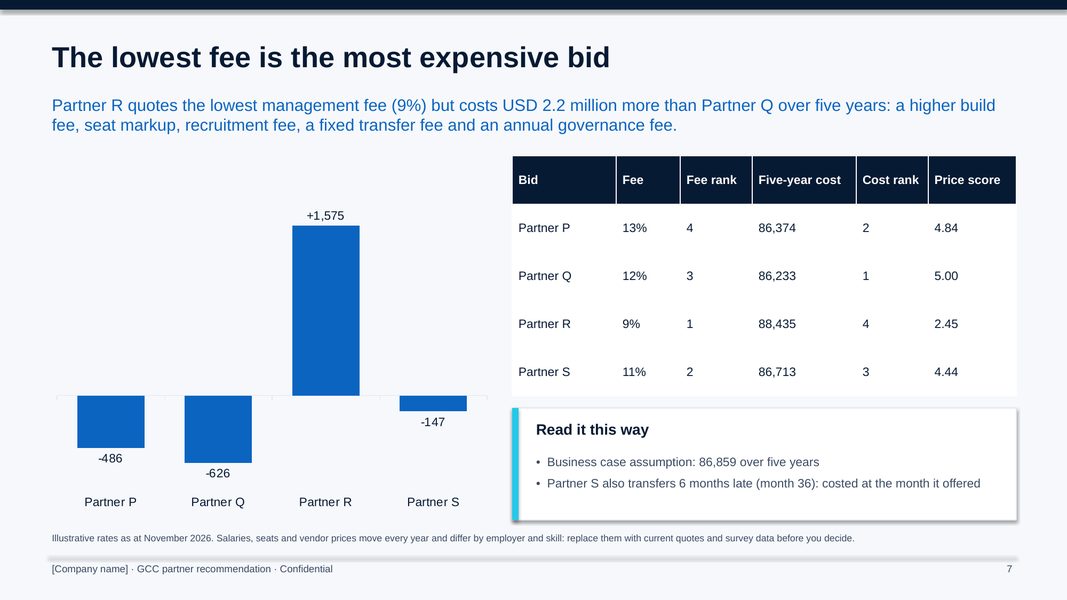
Choose the partner to build your centre: an RFP ready to issue, bids normalised to five-year cost, scoring, due diligence, a BOT term sheet with the transfer price fixed upfront and a negotiation playbook.
2 workbooks2 decks10 documents
GCC Pack
Set up a global capability centre: the business case, operating model, location, roadmap and organisation, and the partner to build it with.
- GCC Setup Kit
- GCC Partner RFP Pack
Read before you decide
Questions
What is a global capability centre?
A global capability centre (GCC) is a company's own offshore unit doing technology, engineering or business operations work for the group: its people, its leaders and its knowledge, even when a partner builds or hosts it. It differs from outsourcing, where a provider delivers the work with its own people.
Who are these tools for?
CIOs, CFOs, COOs and heads of shared services weighing whether to set up a centre, choosing the model and the location, or building one with a partner, and the advisers who help them.
Why India and the Philippines?
They are the two largest destinations for centres serving Western companies, and they complement each other: India for engineering, data and product depth, the Philippines for service desk, finance and business operations. More countries may follow.
Are the rates up to date?
They are dated November 2026 and shown as low, mid and high values. Salaries, seats and vendor prices move every year: the model makes every rate an input so you can replace it with your own quotes.