AI Use Case Prioritisation Kit
Most AI portfolios are a list of the loudest ideas. This kit runs the mechanism that turns ideas into a ranked, funded portfolio: one intake with autonomy level and sourcing route, value sized with finance net of run cost, feasibility, data and risk scored by three people against published anchors, spreads settled in calibration, knock-out rules for what cannot be done, a capacity line that decides how many, balance checks, pilots judged against their charter, and a quarterly re-rank with value realised against sized, all filled in for a worked example.
$89 $45 one-time, no subscription
Excel, PowerPoint and Word files. Yours to use and adapt inside your organisation. Delivered by email at once; 14-day refund promise.
13 working files, not a slide pack to read
Every file is editable and comes with a worked example for one fictional company, so you start from something, not from a blank page. Workbooks calculate as you type.
 Excel
AI use case portfolio workbook
13 sheets: setup with editable lists, rubrics with anchors, one intake, value sizing net of run cost with payback, three scorers per use case, calibration with spreads and low scores flagged, the ranked portfolio with knock-outs, the capacity line and a funded bet, balance by function, quadrant and domain, shared data products, gates and pilots, and the quarterly re-rank. A dashboard pulls it together with 28 checks.
 PowerPoint
AI portfolio committee deck
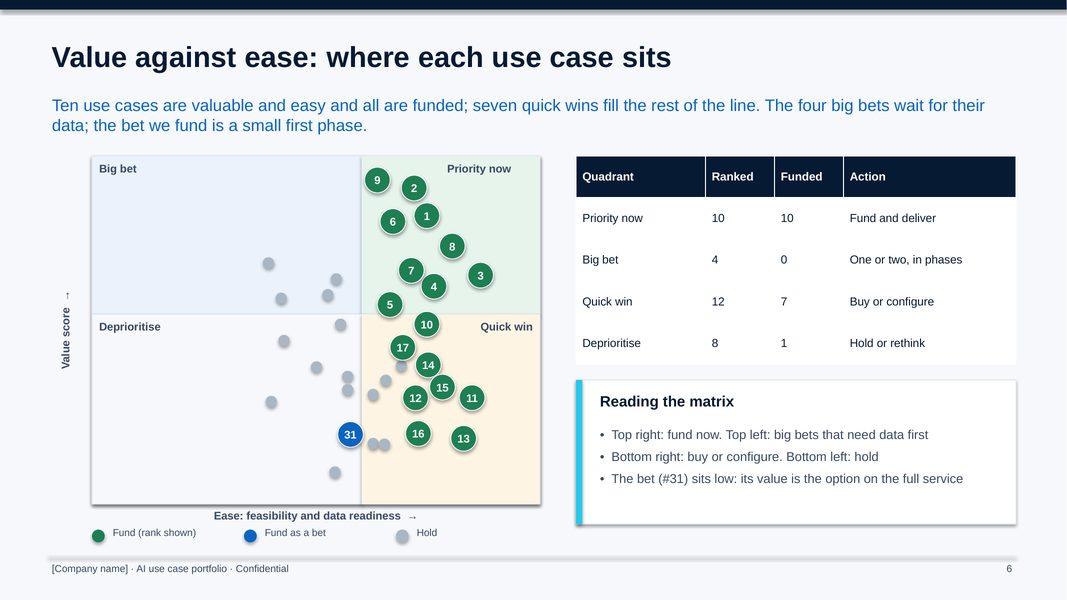
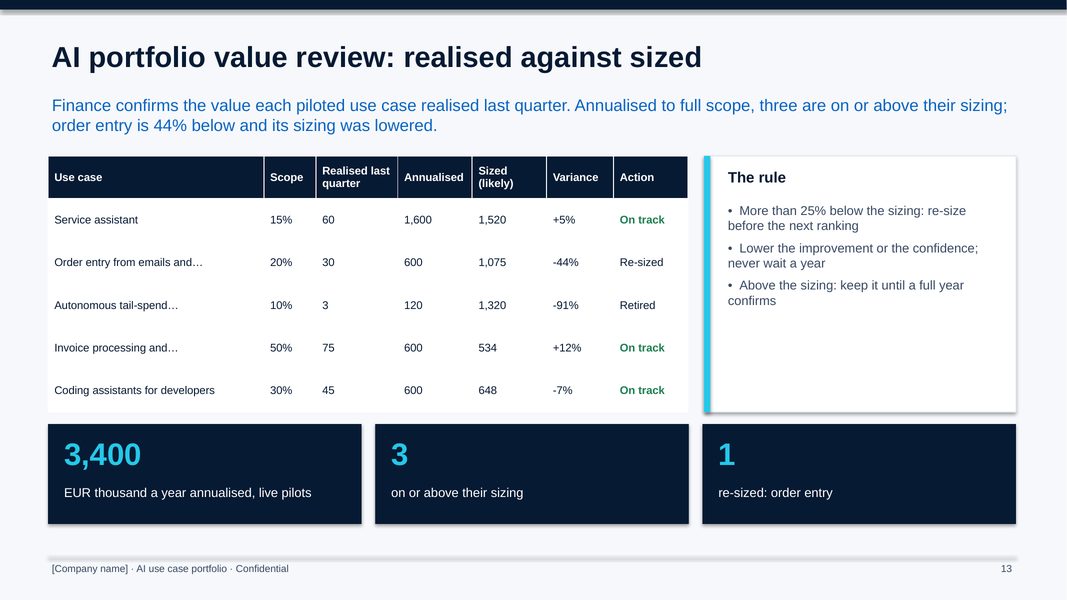
15 slides: the funnel from ideas to the line, how we score, calibration, value against ease, what we fund, the cut line, balance, data products, knock-outs, pilots, value realised against sized, what changed and the decisions.
 PowerPoint
Scoring and calibration workshop deck
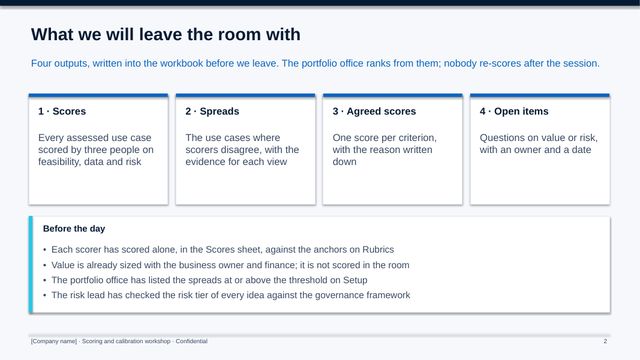
14 slides for a half-day session: roles, the five criteria, the anchors, the risk screen, three exercises on reference cases and spreads, the traps that bend scores and the open items.
 Word
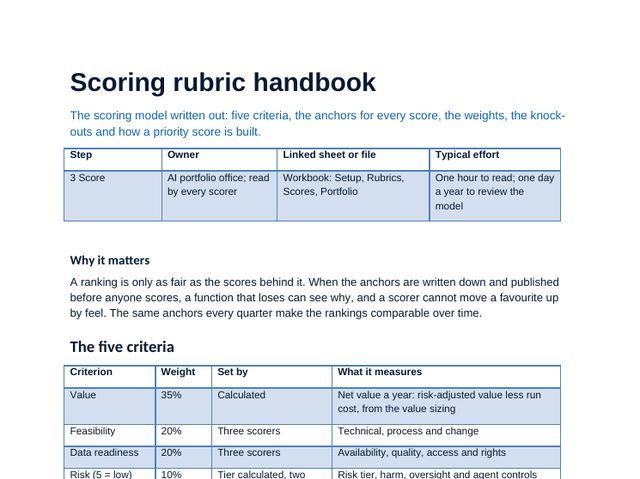
Scoring rubric handbook
The five criteria, the anchors at 1, 3 and 5, the weights and how priority and the cut line are calculated.
 Word
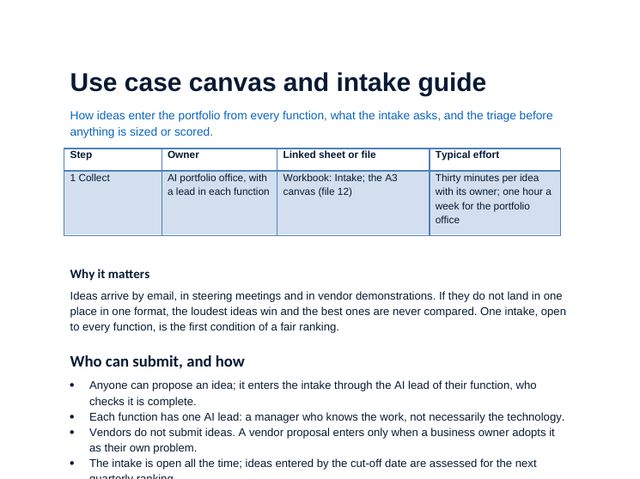
Use case canvas and intake guide
What every idea needs before it is scored: problem, users, autonomy level, sourcing route, data and a first value hypothesis.
 Word
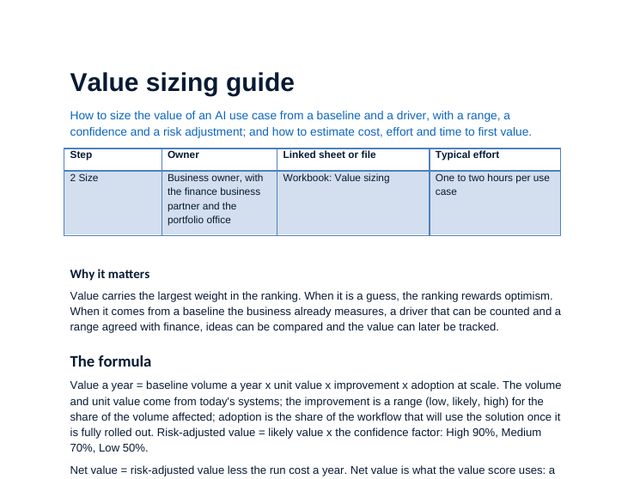
Value sizing guide
Baseline, driver and range agreed with finance, confidence, run cost, and the mistakes that inflate value.
 Word
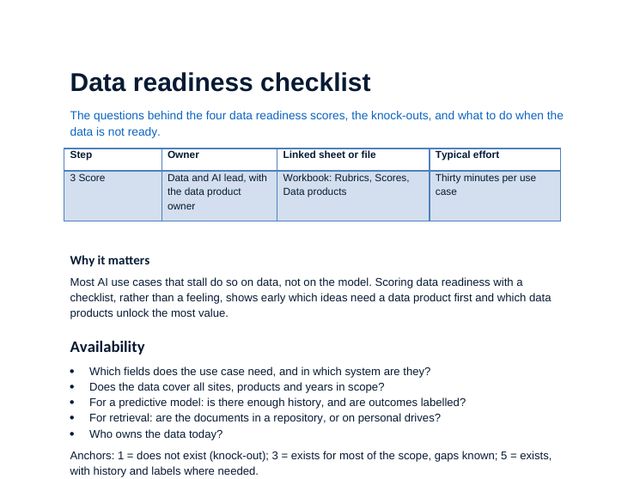
Data readiness checklist
Availability, quality, rights to use and the shared data products, with the sample use cases worked through.
 Word
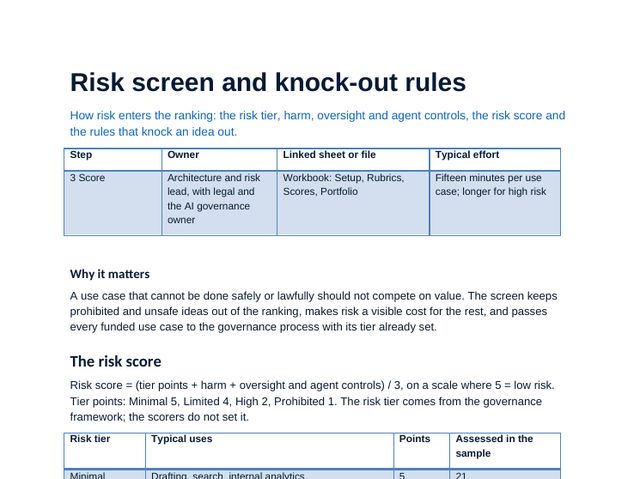
Risk screen and knock-out rules
Risk tiers, harm, oversight and agent controls, and the knock-outs that stop an idea as designed.
 Word
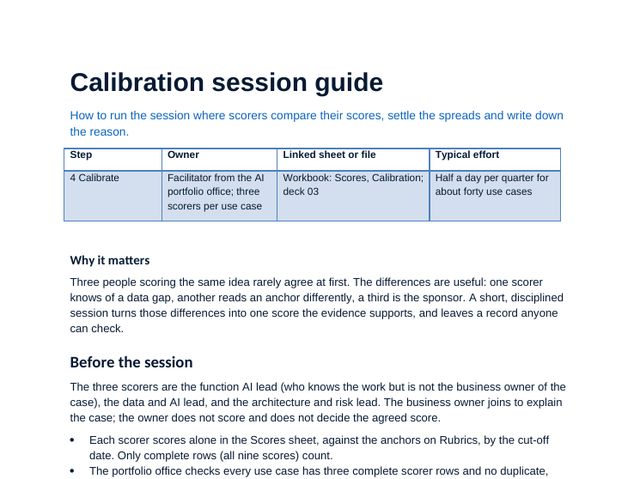
Calibration session guide
How to run the session, read the spreads and record the agreed score with its reason.
 Word
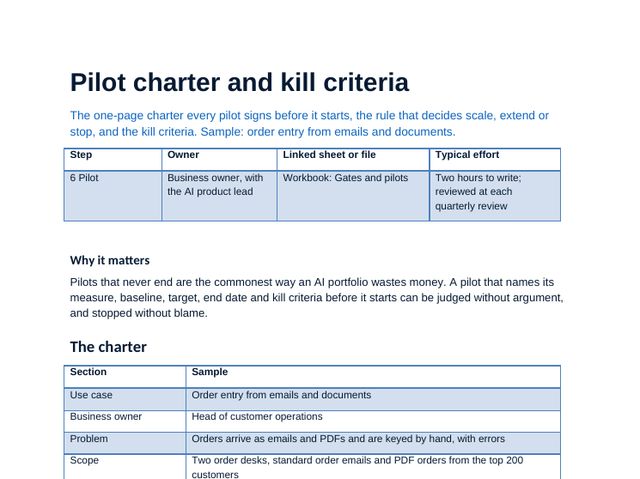
Pilot charter and kill criteria
The charter, the target taken from the sizing, adoption and the rules to scale, extend or stop.
 Word
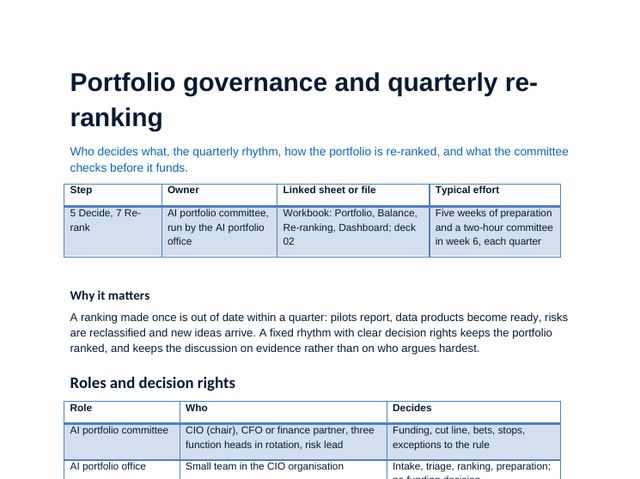
Portfolio governance and quarterly re-ranking
Roles, the quarterly rhythm, value tracking and the rules for moving use cases in and out of the line.
 PDF
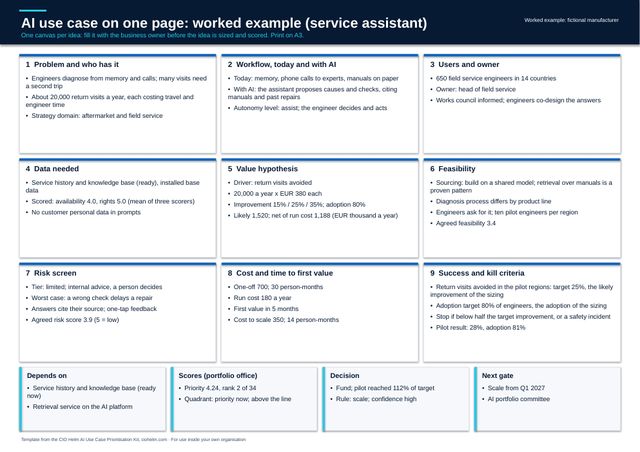
AI use case canvas (A3)
One use case on one A3 page: a blank template for the intake and a worked example.
 Guide
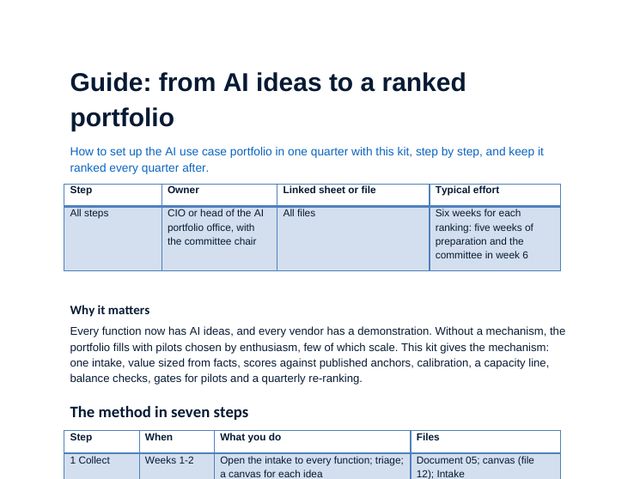
From AI ideas to a ranked portfolio
The method in steps with tips and pitfalls, the first ranking timetable, using the workbook and the mistakes to avoid.
AI use case portfolio workbook, sheet by sheet
The workbook carries the method: scores, choices and plans calculate as you type, and the dashboard and deck figures come from it. Click any image to see it full size.
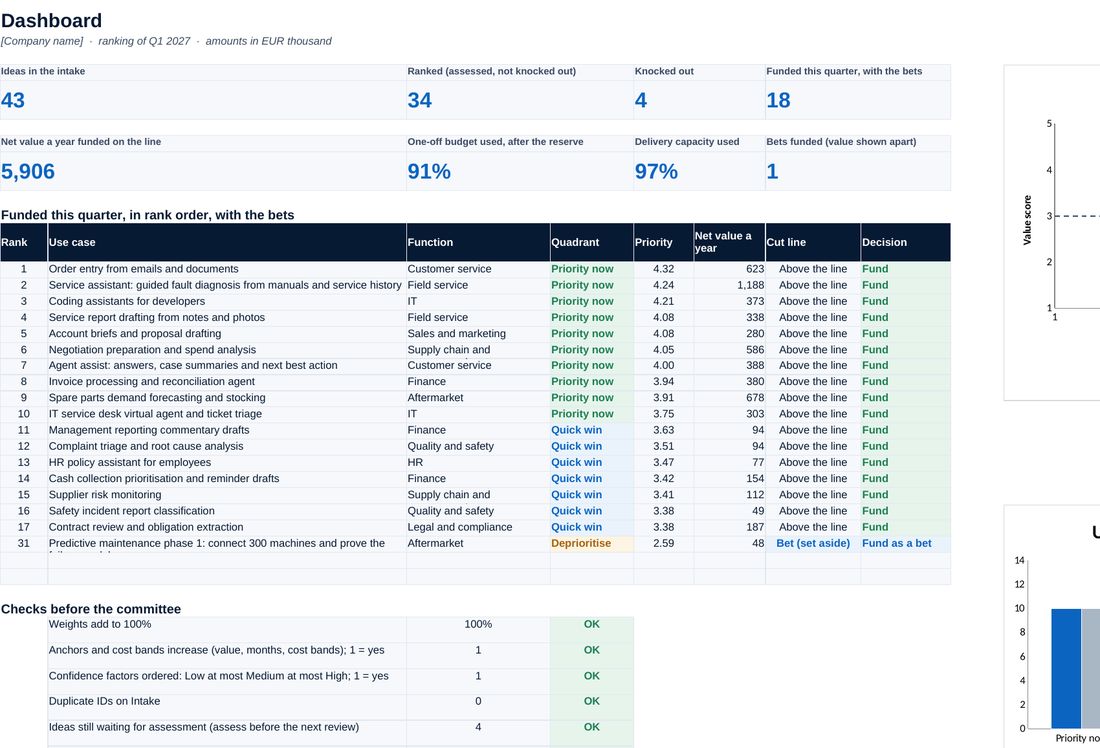
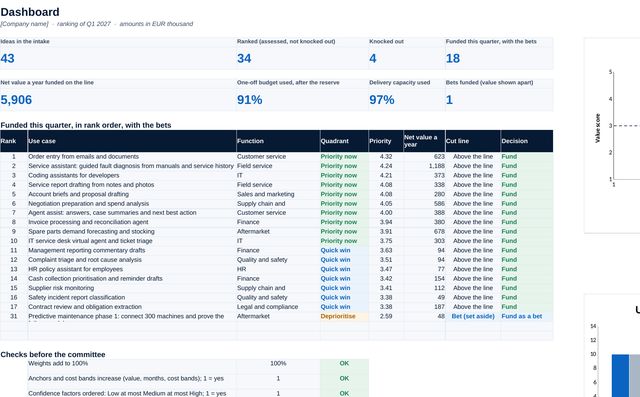
Funnel, the line, money and capacity used, balance and the 28 checks on the workbook.
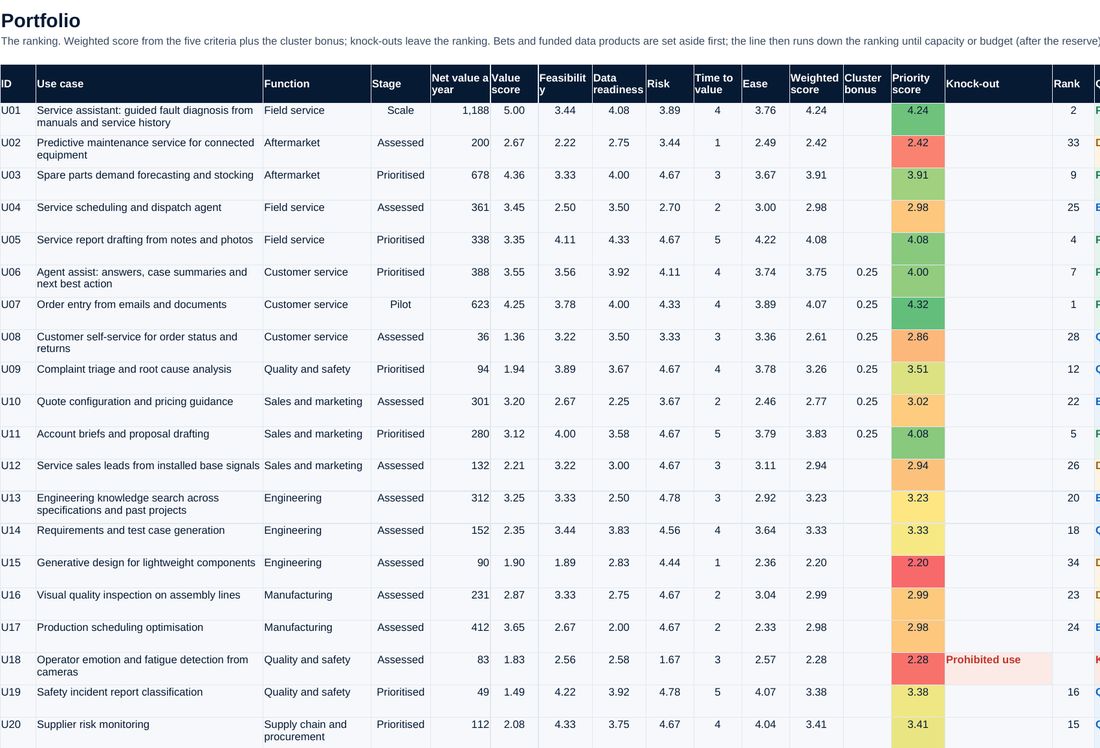
Every use case ranked with its scores, knock-outs, quadrant, the capacity line and the decision.
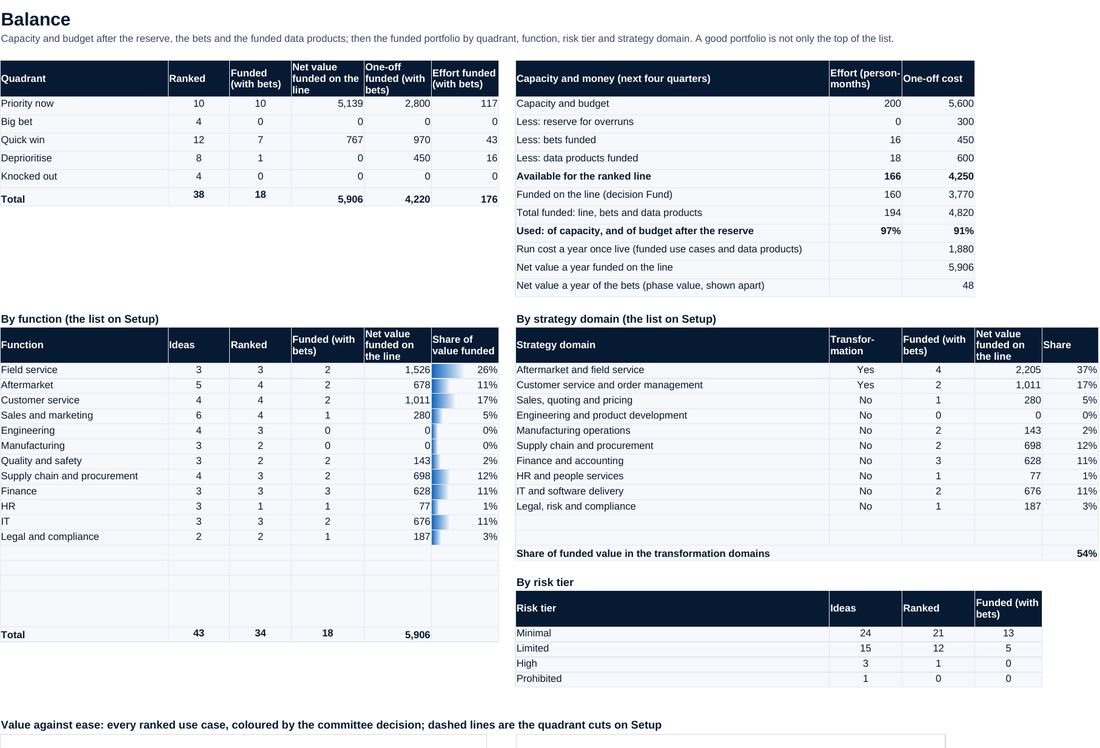
Funded value by function, quadrant and strategy domain, on value against ease.
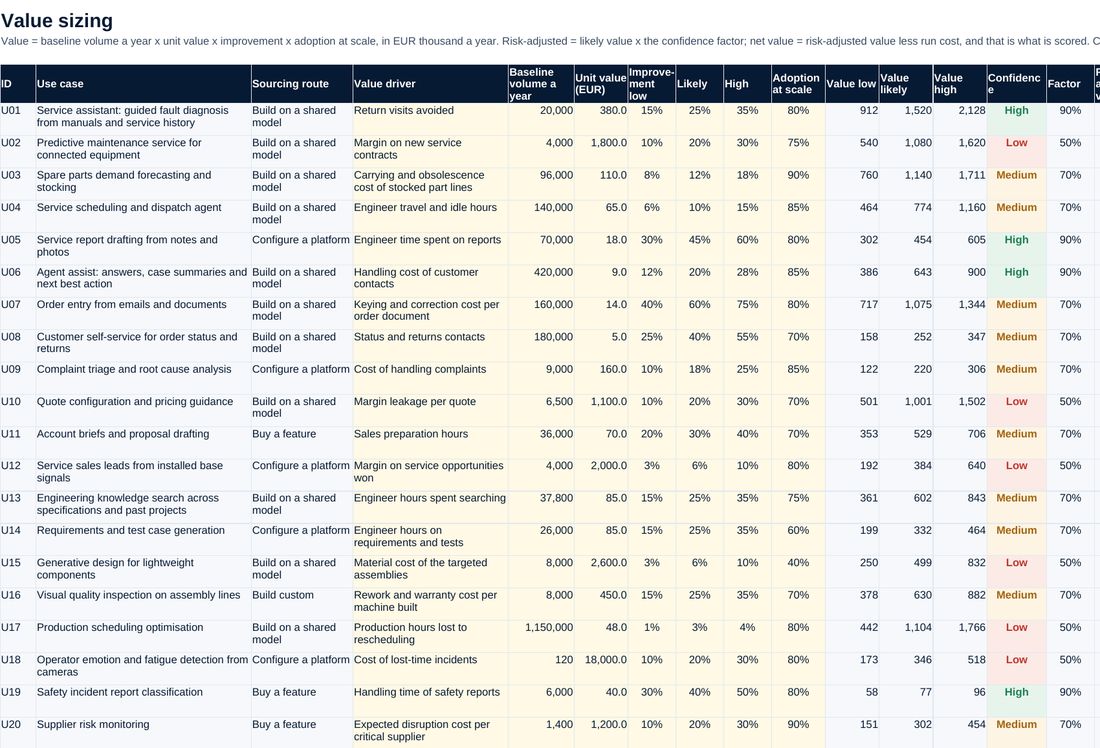
Baseline, driver and range for each use case, net of run cost, with payback and pilot-evidenced value.
Screenshots of the workbook with its sample data, opened in a spreadsheet application.
Capacity decides how many
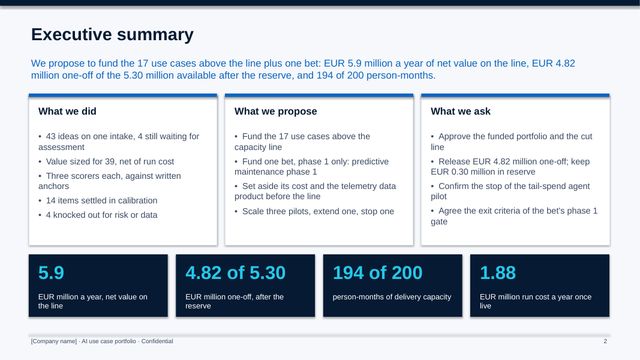
The sample company collects 43 AI ideas from 12 functions. 39 are scored by three people each; calibration settles seven spreads and seven low scores, and four ideas are knocked out. Of 34 ranked, the first 17 fit the 200 person-months available once phase 1 of predictive maintenance and its telemetry data product are set aside as a bet. The line carries EUR 5.9 million a year of net value for EUR 4.82 million one-off, no function holds more than 26% of the value, and the pilots scale three, extend one and stop one.
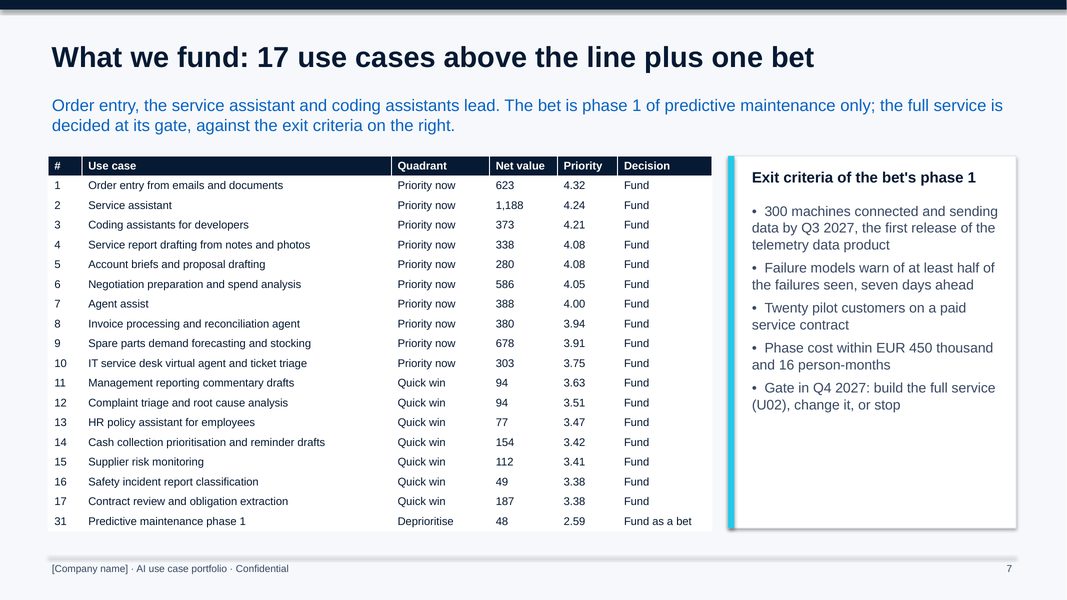
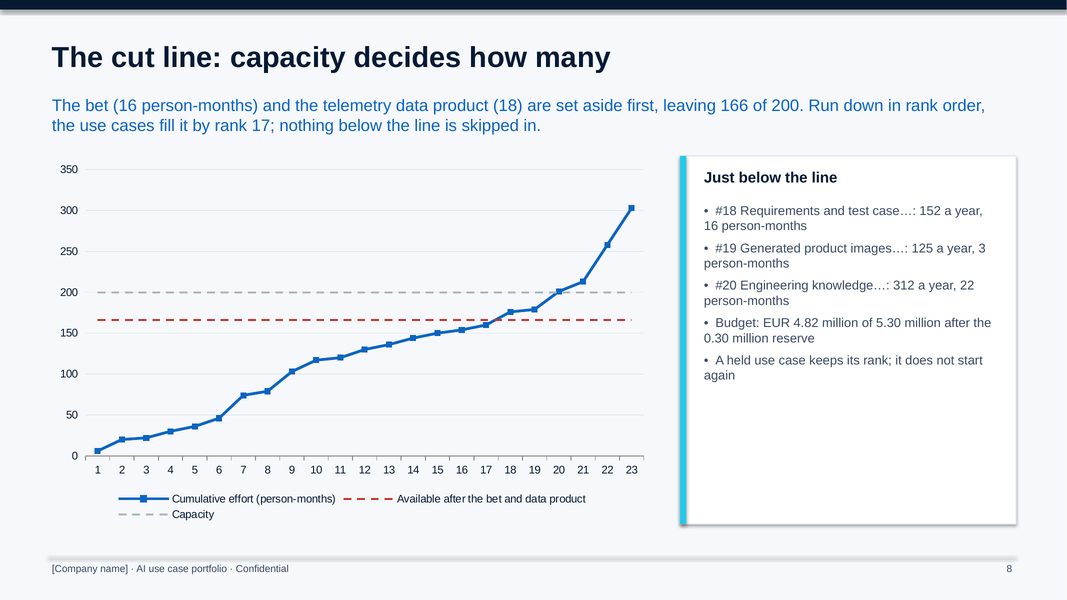
All figures shown are sample data.
The method, step by step
Open one intake, collect ideas with the canvas and size value with finance.
Three scorers per use case against the published anchors, in the workbook.
Half a day on the spreads and low scores; agree each score with its reason.
Apply the knock-outs, draw the capacity line, check balance and take the portfolio to the committee; re-rank every quarter.
Who it is for
- CIOs and chief data or AI officers with more AI ideas than capacity
- AI portfolio offices and centres of excellence running the quarterly cycle
- Business leaders who want a fair, published way to get their idea funded
- Advisers setting up AI portfolio management for a client (one licence per client organisation)
What you need
Excel, PowerPoint and Word, or compatible software. A first ranking takes about six weeks; each quarterly re-rank about two.
Free guides on this topic
Questions about the kit
How is it different from the AI Strategy Builder and the AI Readiness Action Kit?
The readiness kit has a simple use case scorer for a first list. The strategy kit chooses the domains and the value case. This kit runs the portfolio inside that strategy every quarter: intake, scoring with calibration, the capacity line, pilots and re-ranking.
How does it relate to the Technology Investment Prioritisation Kit?
This kit ranks AI use cases against AI capacity. Its funded portfolio then enters the enterprise investment line, where the Technology Investment Prioritisation Kit decides the annual funding across all technology requests.
Does it handle AI agents?
Yes. Every idea has an autonomy level, agent controls are scored in the risk screen, and an agent without controls is a knock-out.
Is the company in the example real?
No. The manufacturer and its figures are fictional. Replace them with your own.
How do I get it?
Checkout is run by Creem, our reseller and merchant of record, which also handles tax and your invoice. As soon as the payment is confirmed we email you a private link to download the kit. Not what you expected? Ask within 14 days for a full refund.
Is it legal or financial advice?
No. The templates are practical starting points for management decisions. Have policies and contracts reviewed against the law that applies to your company.
Who can use it?
You and your colleagues, inside your own organisation. Advisers need one licence per client organisation. Please do not resell or republish it.