Build vs Buy Kit
Most build or buy decisions are settled by the loudest voice before any number exists. This kit frames the decision, tests whether the capability really differentiates, compares whole options (extend, build, buy, configure a platform, partner, compose) on five-year cost with exit, speed, capability fit and vendor and lock-in risk, sets the weights before the scores, shows what would change the answer and hands guardrails to the product selection, all filled in for a worked example.
$89 $45 one-time, no subscription
Excel, PowerPoint and Word files. Yours to use and adapt inside your organisation. Delivered by email at once; 14-day refund promise.
13 working files, not a slide pack to read
Every file is editable and comes with a worked example for one fictional company, so you start from something, not from a blank page. Workbooks calculate as you type.
 Excel
Build vs buy workbook
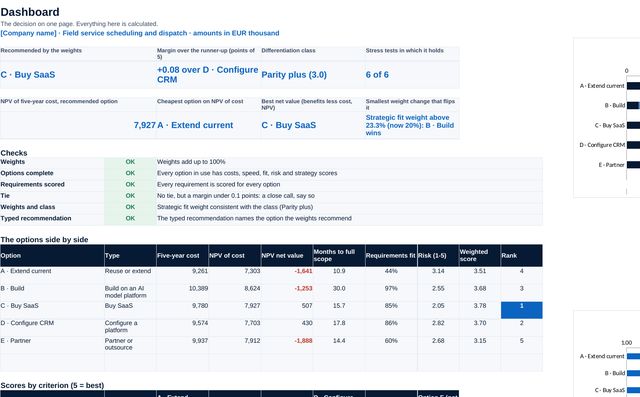
15 sheets: setup, frame, differentiation test, up to six options, cost inputs and an assumptions register, five-year cost of ownership with exit and net present value, eight stress tests, speed, capability fit, twelve risk factors, the weighted decision with checks, the weight that flips it, guardrails for selection and a portfolio view of other capabilities. A dashboard pulls it together.
 PowerPoint
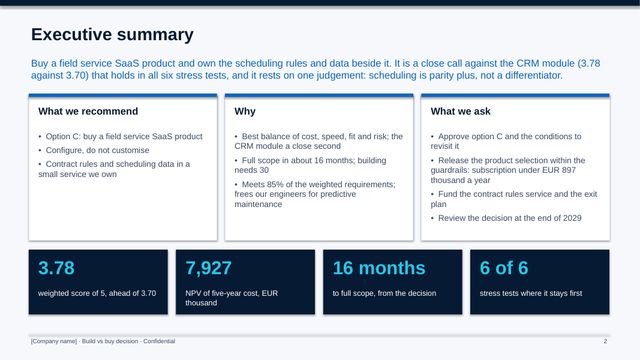
Build vs buy decision paper
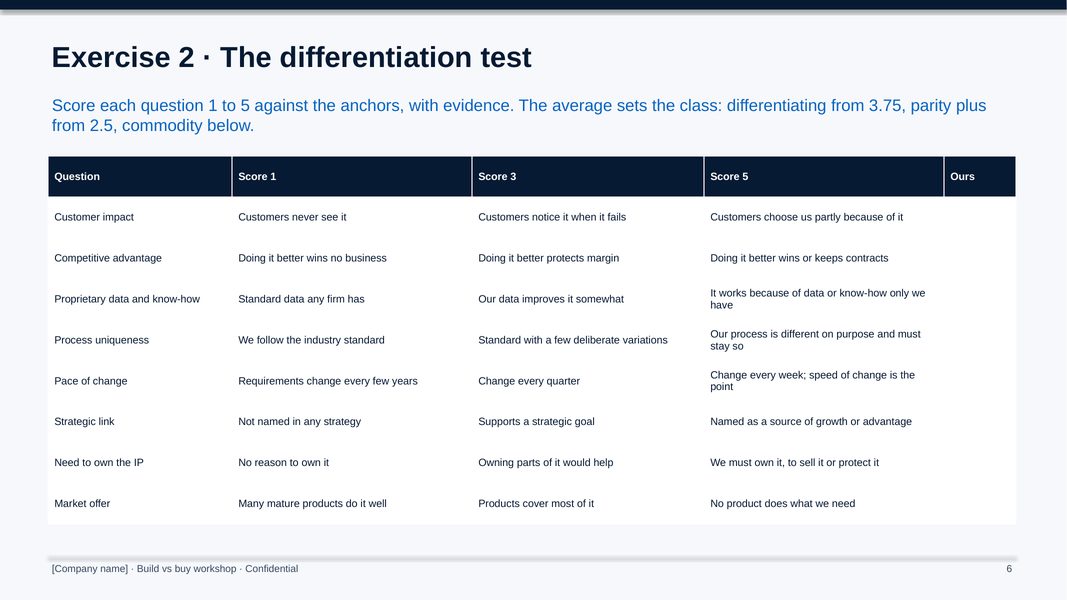
16 slides for the architecture board and executive committee: the decision, the differentiation test, the options, five-year cost, sensitivity, speed, fit, risk, the weighted decision, what would change it, guardrails, the recommendation and the decisions.
 PowerPoint
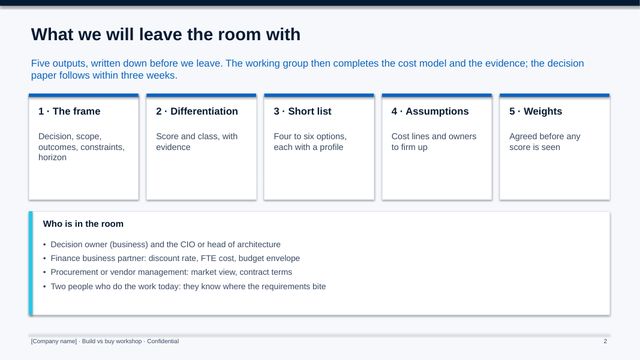
Build vs buy assessment workshop
13 slides for a half-day session: five traps, six exercises from framing to weights, and how to read the result.
 Word
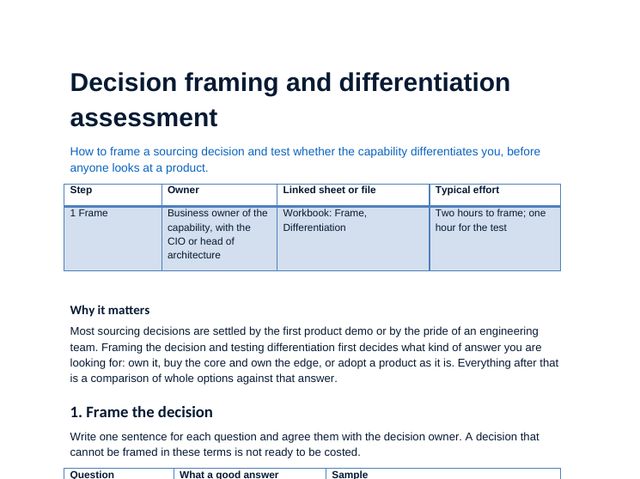
Decision framing and differentiation assessment
The decision statement, scope and outcomes, and the differentiation test with anchors and a worked example.
 Word
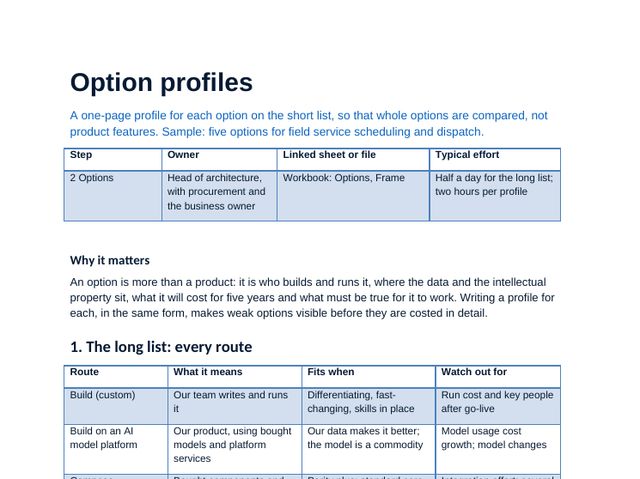
Option profiles
The long list including the AI-era routes, and a profile of each short-listed option: what it is, what we own, what we depend on.
 Word
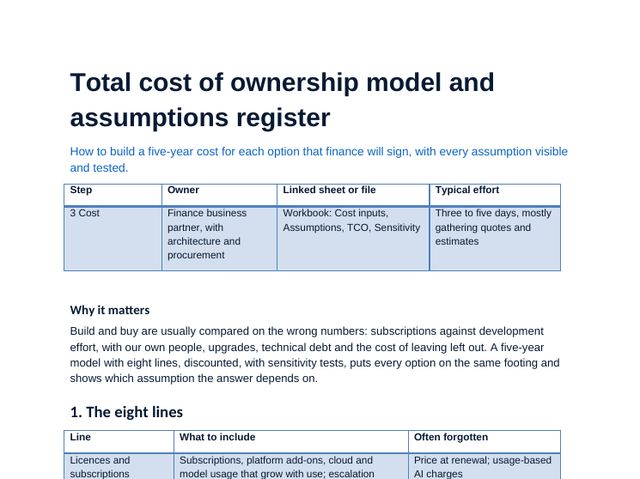
TCO model guide and assumptions register
The eight cost lines, how the five-year cost and NPV are built, the AI-era adjustments and every assumption with its confidence.
 Word
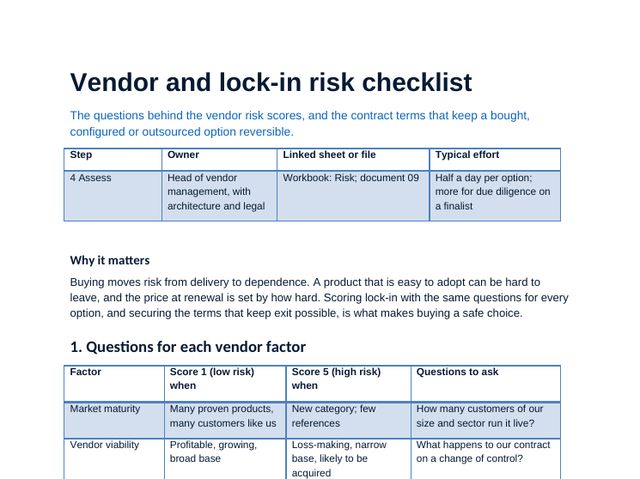
Vendor and lock-in risk checklist
Twelve risk factors with anchors, the contract terms that limit lock-in and the AI-specific questions.
 Word
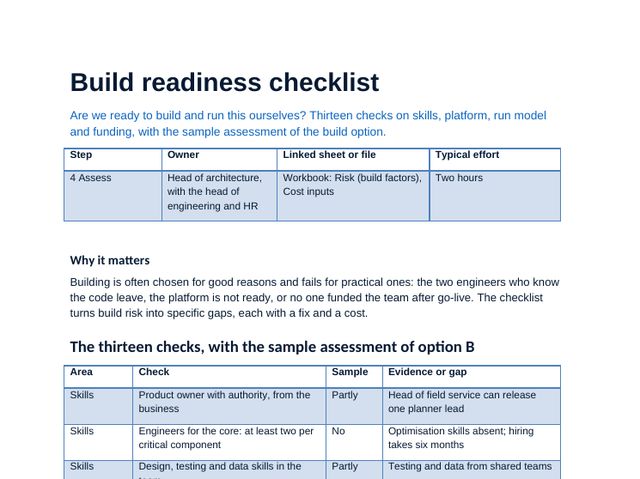
Build readiness checklist
Thirteen checks before you build: skills, platform, funding, opportunity cost and the product team you will need for years.
 Word
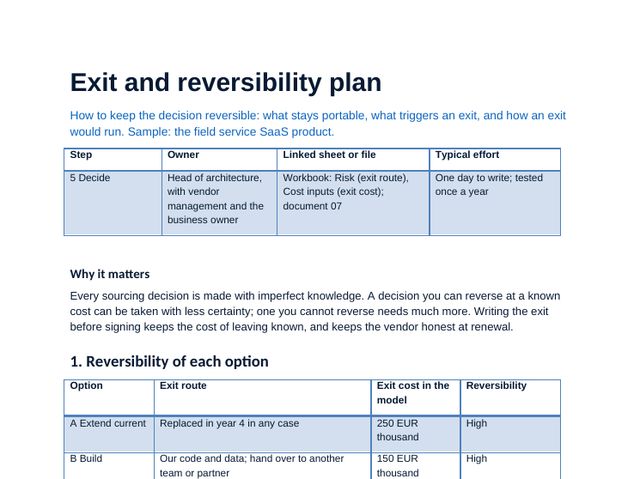
Exit and reversibility plan
What it takes to leave each option, the triggers to look again and the clauses to write in on day one.
 Word
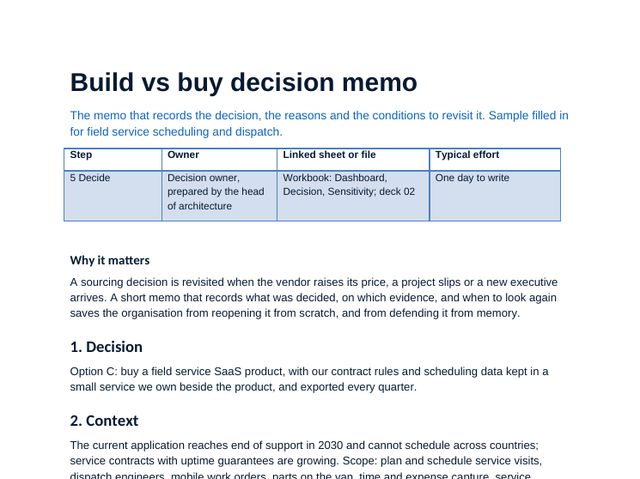
Build vs buy decision memo
The filled-in memo: recommendation, reasons, open assumptions, conditions and the handover to selection.
 Word
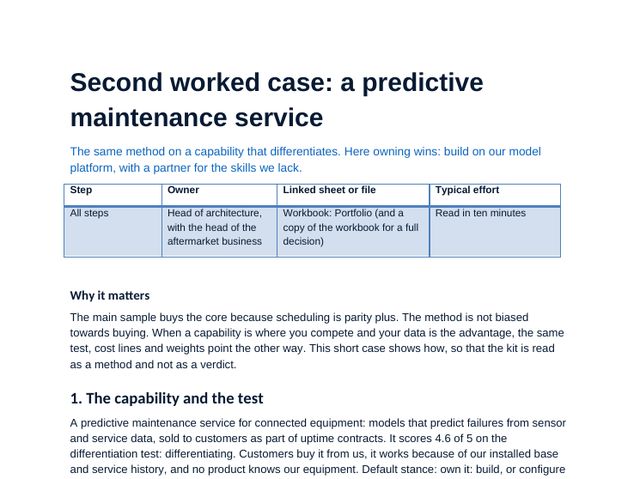
Second worked case: predictive maintenance
A contrasting case where owning wins: build on the model platform and partner for the skills.
 PDF
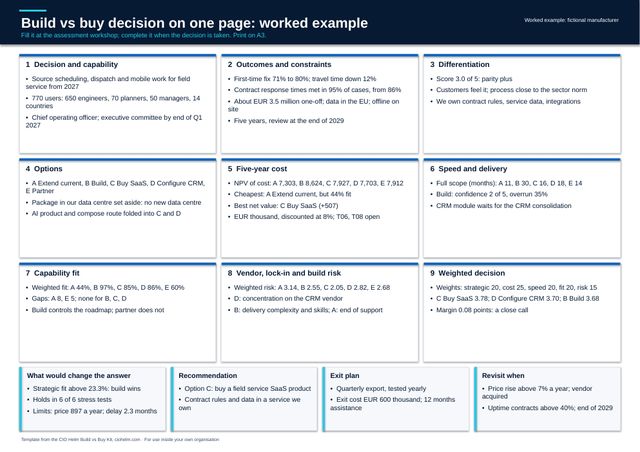
Build vs buy decision canvas (A3)
The whole decision on one A3 page: a blank template for the workshop and a worked example.
 Guide
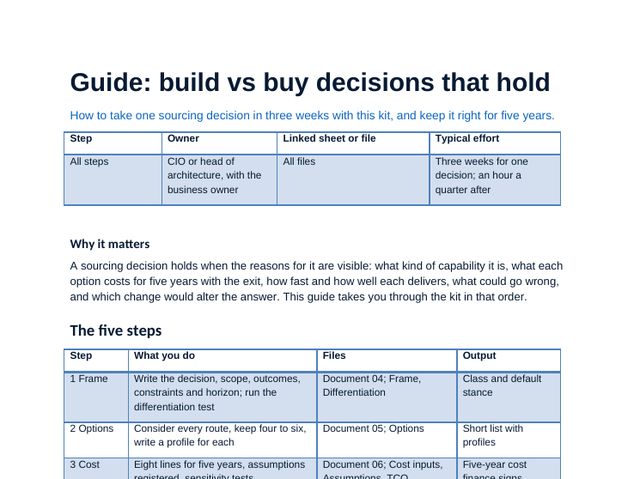
Build vs buy decisions that hold
The method in steps with tips and pitfalls, a sample timetable, using the workbook and the mistakes to avoid.
Build vs buy workbook, sheet by sheet
The workbook carries the method: scores, choices and plans calculate as you type, and the dashboard and deck figures come from it. Click any image to see it full size.
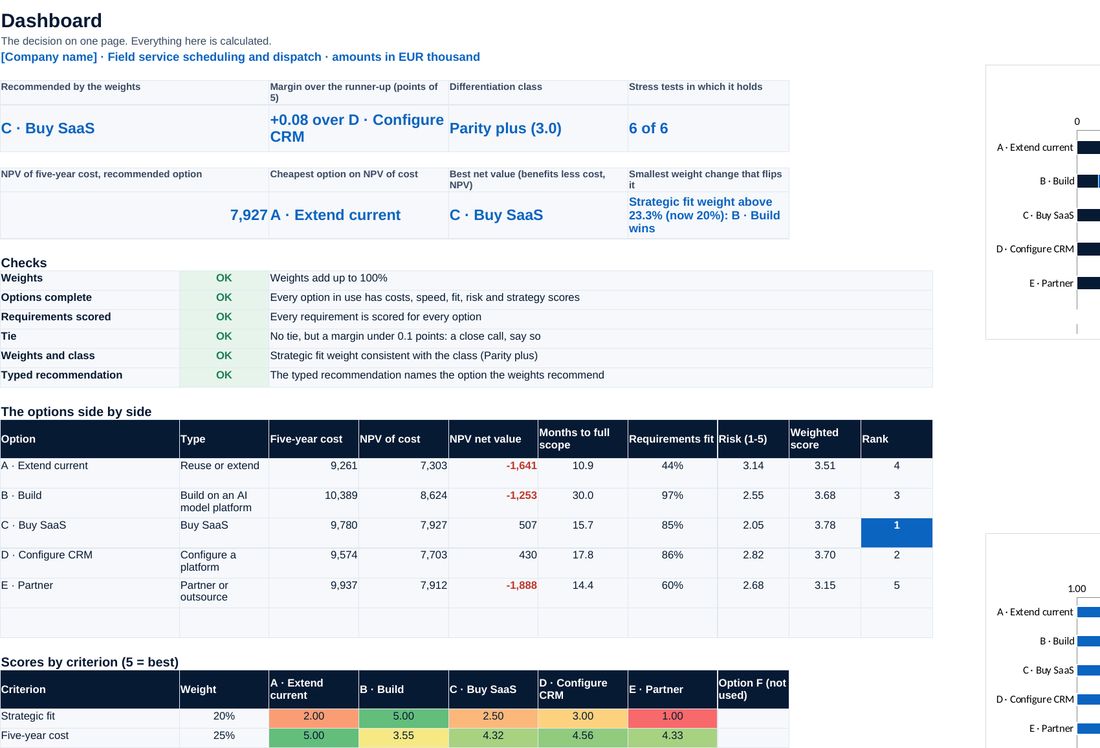
The recommendation, the margin, cost, speed, fit and risk by option, the checks and the guardrails.
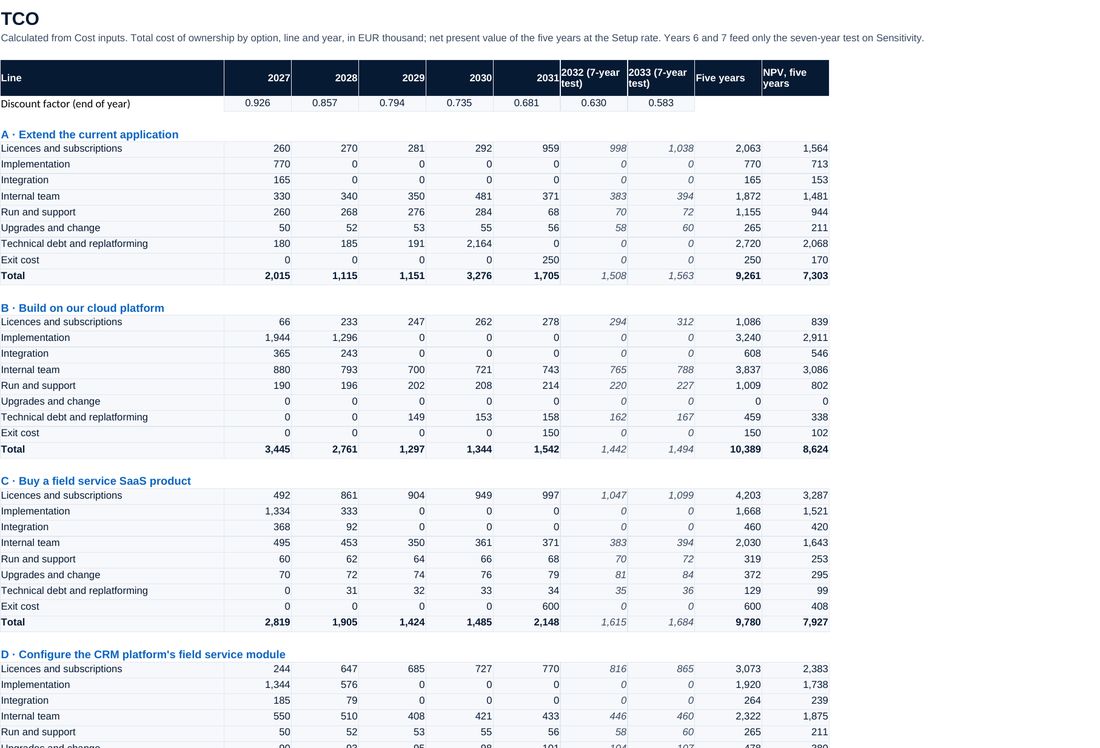
Eight cost lines by year for every option, with exit cost, five-year total and net present value.
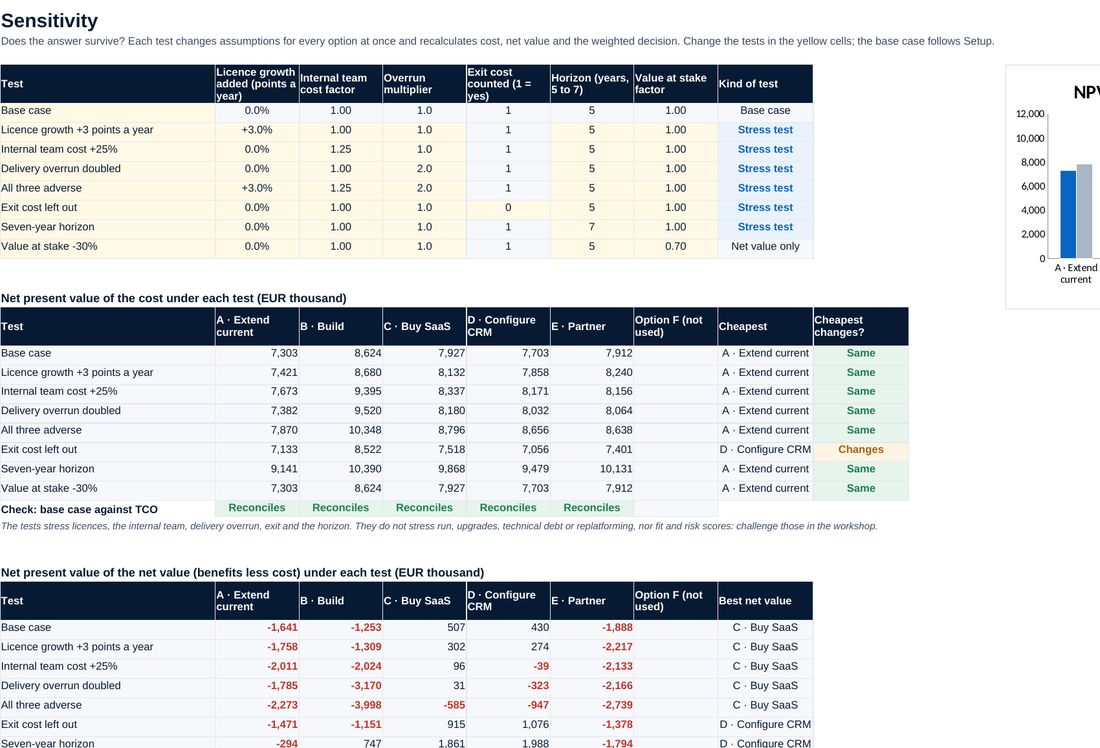
Eight stress tests on cost and value, with the cheapest and the recommended option in each.
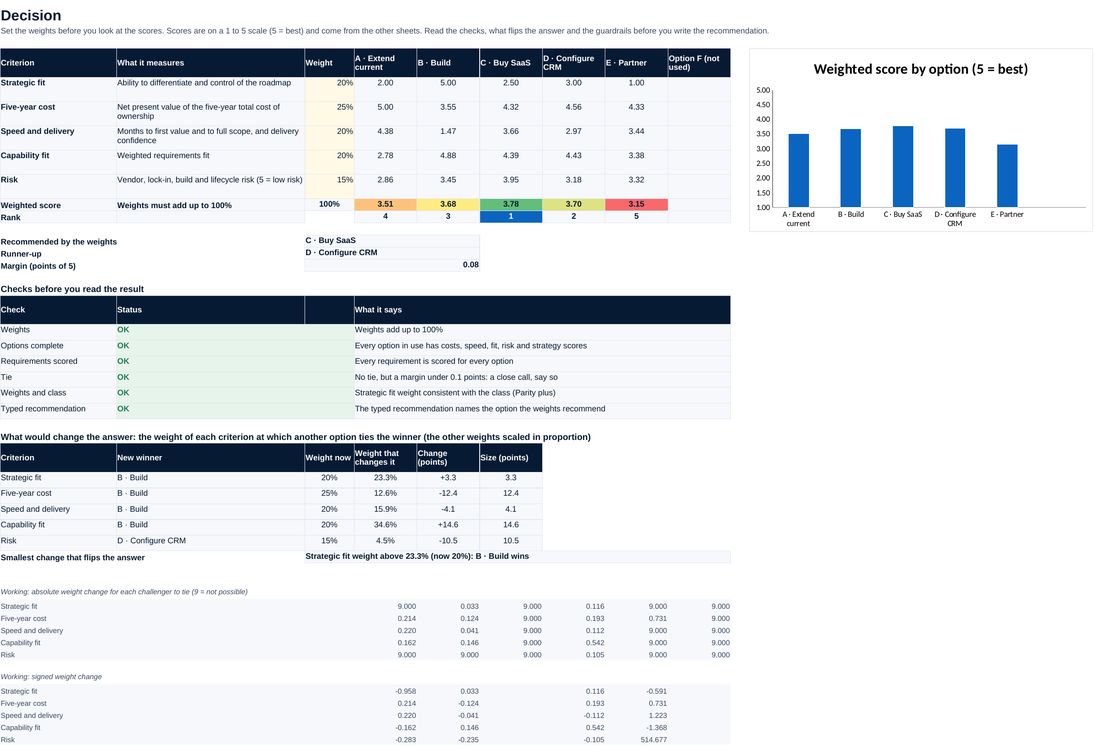
Weighted scores, the weight that flips the answer, the checks and the guardrails for selection.
Screenshots of the workbook with its sample data, opened in a spreadsheet application.
A close call, made in the open
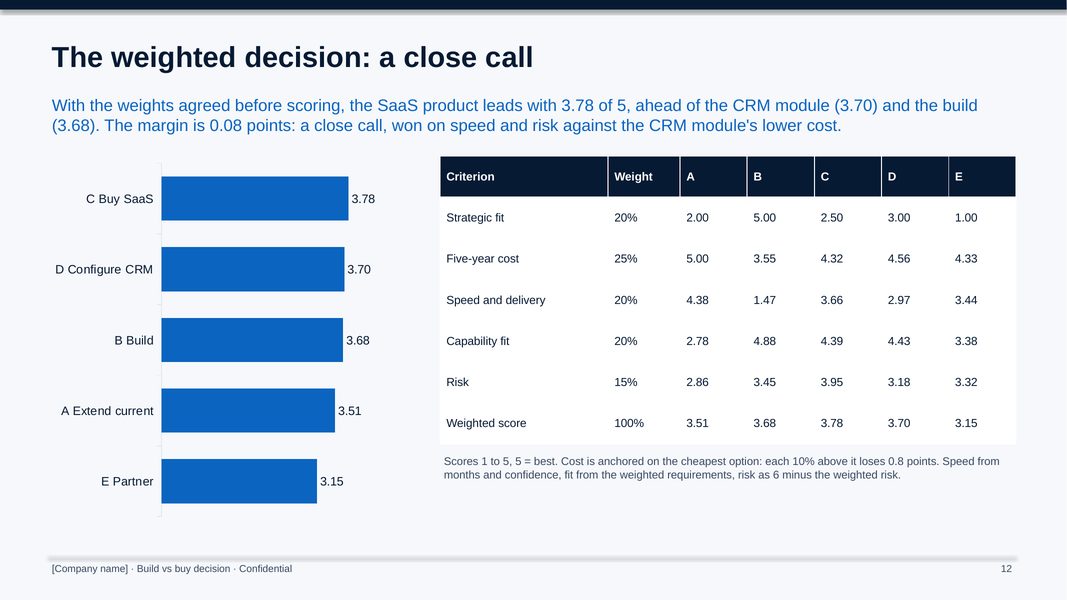
The sample company decides how to source field service scheduling and dispatch for 650 engineers in 14 countries. Scheduling is parity plus, not a differentiator. Four options cost within 9% of each other over five years; building costs 18% more and delivers in 30 months against about 16. Buying a SaaS product scores 3.78 of 5 against 3.70 for the CRM module, holds in six stress tests, and would flip to building only if strategic fit weighed above 23%. The selection gets three guardrails: a subscription below EUR 897 thousand a year, escalation below 9.4% and under 2.3 months of delay.
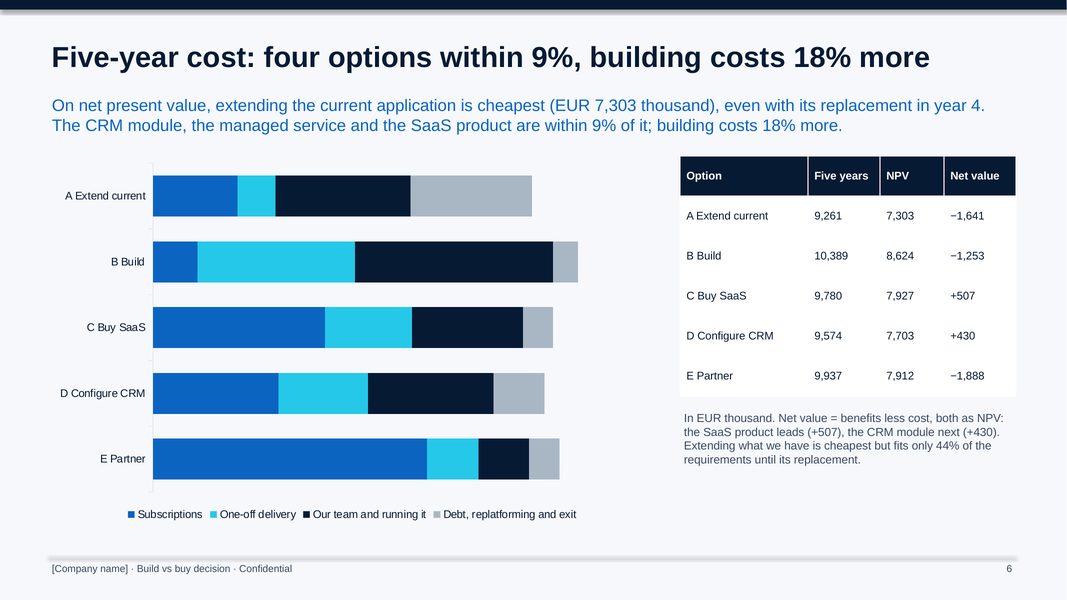
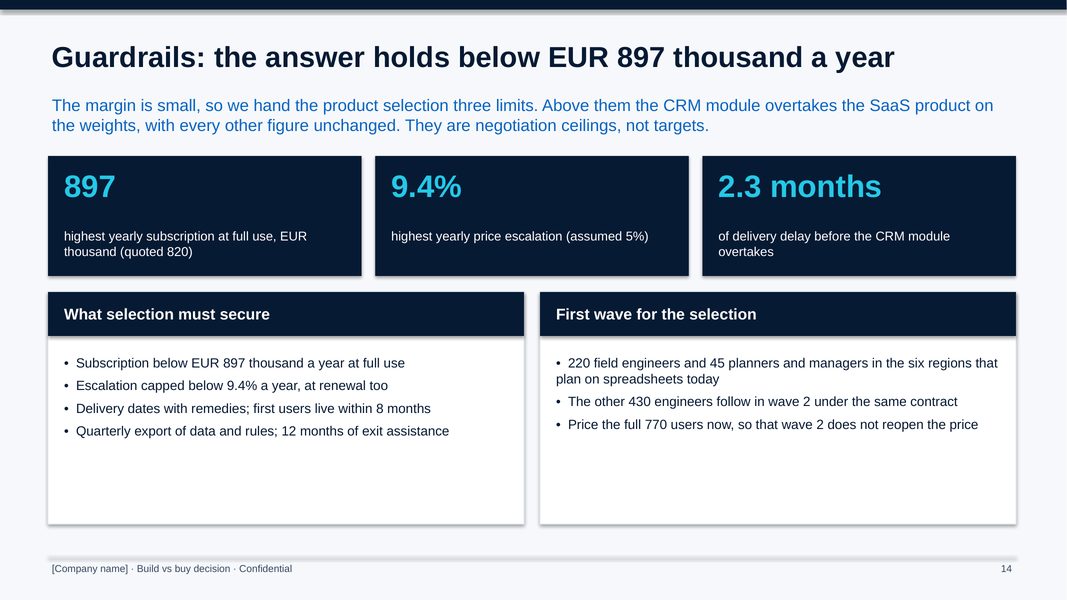
All figures shown are sample data.
The method, step by step
Write the decision, scope and outcomes, and run the differentiation test with the business owner.
Move from the long list to four to six whole options, including extending what you have.
Build the five-year cost with exit, agree the scales and score every option with evidence.
Set the weights before the scores, read the sensitivity and take the paper to the board.
Who it is for
- CIOs and enterprise architects facing a build, buy or partner decision
- Architecture boards and investment committees that want the same method every time
- Product and platform leads making the case for owning a capability
- Advisers supporting a sourcing decision for a client (one licence per client organisation)
What you need
Excel, PowerPoint and Word, or compatible software. One decision takes about five weeks with a half-day workshop.
Free guides on this topic
Questions about the kit
How is it different from the Solution Selection Kit?
This kit decides whether to build, buy, configure, partner or extend. When the answer is to buy, the Solution Selection Kit chooses the vendor, using the guardrails this kit produces as price and delivery limits.
Does it cover AI options?
Yes. The long list includes building on a model platform, buying an AI product and composing bought components around your own core, and the cost and risk sections cover model usage, outcome pricing and AI-specific lock-in.
Can we change the weights, options and cost lines?
Yes. Weights, discount rate, inflation, horizon and up to six options are inputs; the cost, scores, sensitivity and dashboard follow.
Is the company in the example real?
No. The manufacturer and its figures are fictional. Replace them with your own.
How do I get it?
Checkout is run by Creem, our reseller and merchant of record, which also handles tax and your invoice. As soon as the payment is confirmed we email you a private link to download the kit. Not what you expected? Ask within 14 days for a full refund.
Is it legal or financial advice?
No. The templates are practical starting points for management decisions. Have policies and contracts reviewed against the law that applies to your company.
Who can use it?
You and your colleagues, inside your own organisation. Advisers need one licence per client organisation. Please do not resell or republish it.