GCC Setup Kit
Very few executives have set up a capability centre, and most of the advice comes from people who sell one. This kit takes you from the decision to a running centre the way people who have built them would: the operating model chosen on ten weighted criteria with the five-year cost from the GCC Cost Model, captive, BOT, managed GCC, GCC-as-a-service and hybrid compared honestly, a hub and spoke chosen from six cities and two tier-2 options, the entity, tax and labour steps for India and the Philippines with lead times, a roadmap to transfer at month 30 with its critical path, leaders hired first, the onshore people impact in whole people, the downside case, a hiring plan checked against recruiter capacity, knowledge transfer wave by wave with entry and exit criteria, governance with decision rights and KPIs, concentration risk assessed beyond headcount and a maturity path through four stages, all filled in for a worked example.
$149 $75 one-time, no subscription
Excel, PowerPoint and Word files. Yours to use and adapt inside your organisation. Delivered by email at once; 14-day refund promise.
14 working files, not a slide pack to read
Every file is editable and comes with a worked example for one fictional company, so you start from something, not from a blank page. Workbooks calculate as you type.
 Excel
GCC setup workbook
15 sheets: setup with the cost results from the GCC Cost Model, a dashboard with checks, an operating model selector on ten weighted criteria with a weight test and a decision tree per workstream, a location scorecard for eight cities with hub and spoke results, an entity and legal tracker for India and the Philippines with dates and alerts, a 30-month roadmap with a Gantt and critical path, org design with spans and layers, role profiles mapped to the CIO Helm roles library, a hiring plan with attrition, offers and recruiter capacity, a transition plan per workstream, governance with decision rights and KPIs, a risk register with concentration scoring, and a maturity self-assessment.
 PowerPoint
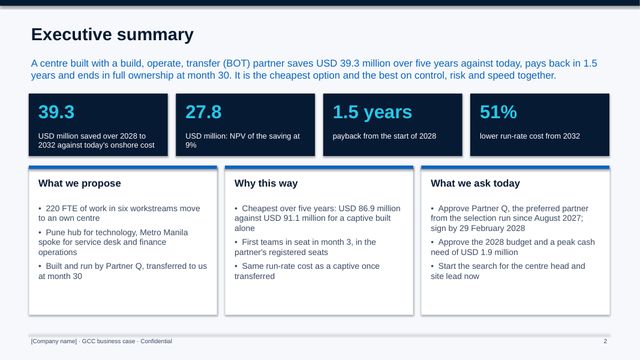
GCC business case (executive committee and board)
19 slides: why a centre now, scope, four options costed over five years, the operating model choice, BOT against captive and GCC-as-a-service, location, the roadmap, organisation, what it means for our people, governance, risks and concentration, the downside, what we must believe, the ask and the decisions.
 PowerPoint
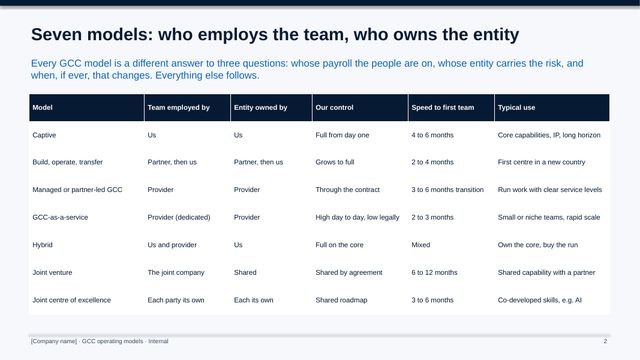
GCC operating models
15 slides, the reference deck: captive, BOT, managed GCC, GCC-as-a-service, hybrid, joint ventures and joint centres of excellence, hub and spoke, centre of excellence or full-stack, four maturity stages, a decision tree, the selector, cost over time, how models change and the pitfalls of each.
 Word
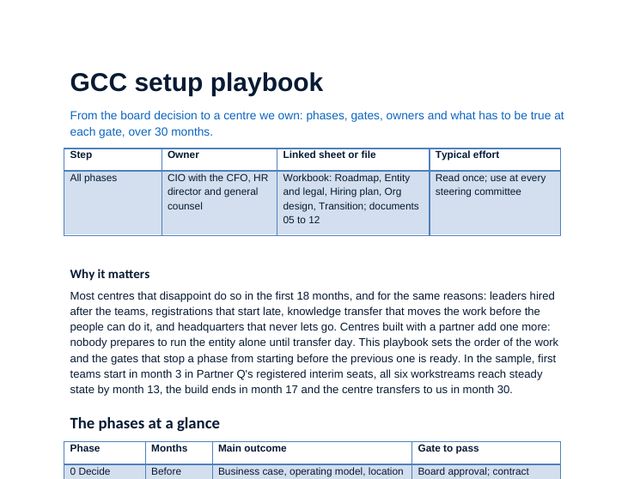
GCC setup playbook
From decision to transfer, phase by phase, with the gates, own operations before transfer, what the steering committee looks at every month and the mistakes to avoid.
 Word
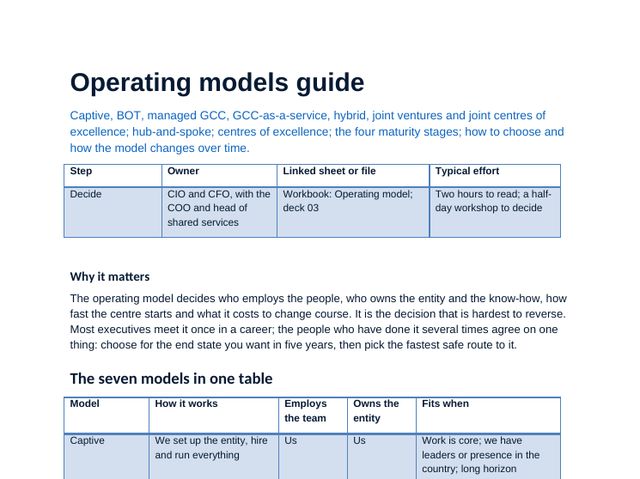
Operating models guide
Seven models compared on twelve criteria, how each works, when it fits, what it takes and its pitfalls, hub and spoke, centres of excellence, the four maturity stages, how to choose workstream by workstream, what practitioners learn late and how models change over time.
 Word
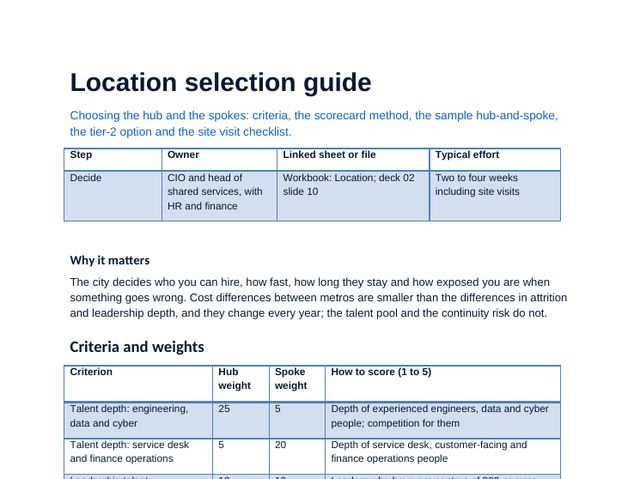
Location selection guide
Criteria and weights for a hub and a spoke, the cost per FTE by city, the tier-2 option, a site visit checklist and pitfalls.
 Word
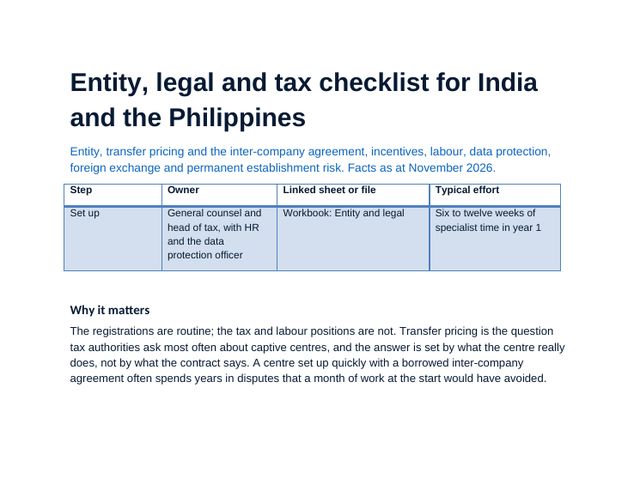
Entity, legal and tax checklist (India and the Philippines)
Entity, foreign investment, transfer pricing, incentives, tax, labour, data protection and permanent establishment, as at November 2026, with the inter-company agreement in plain words and questions for counsel.
 Word
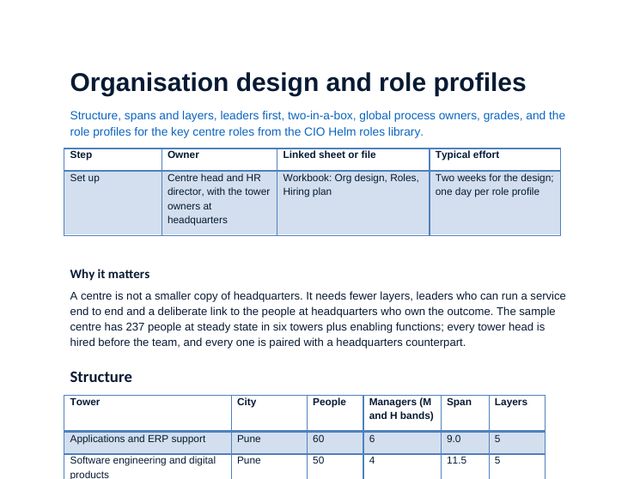
Organisation design and role profiles
Structure by tower, spans and layers, grades, leaders first, two-in-a-box, global process owners and profiles for the key centre roles.
 Word
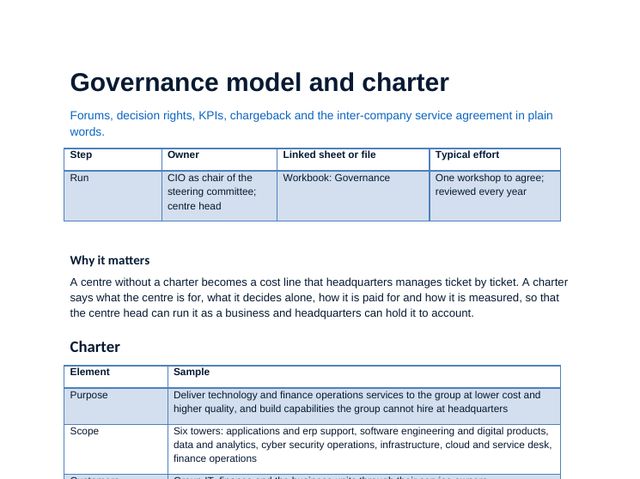
Governance model and charter
The charter, forums, decision rights, KPIs with targets, chargeback and the annual cycle.
 Word
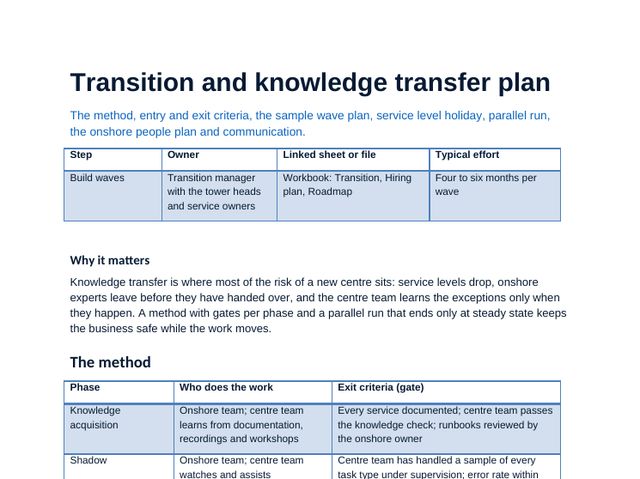
Transition and knowledge transfer plan
The method, entry and exit criteria, a sample wave plan, service level holiday, parallel run, the onshore people plan and communication.
 Word
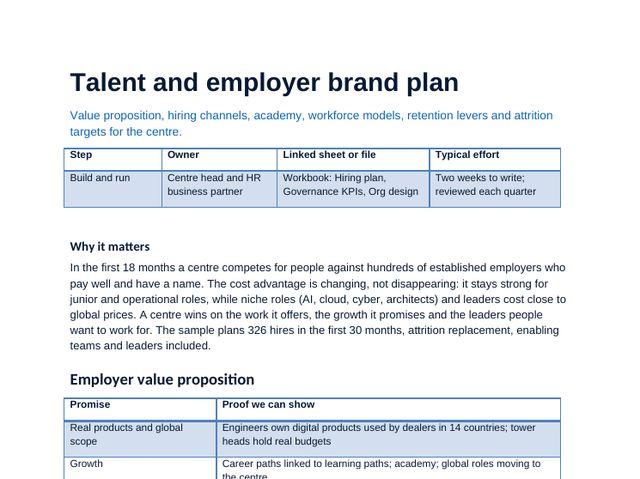
Talent and employer brand plan
Value proposition, hiring channels and capacity, salary benchmarking, counter-offers, 30, 60 and 90 day onboarding, retention levers and attrition targets with early warnings.
 Word
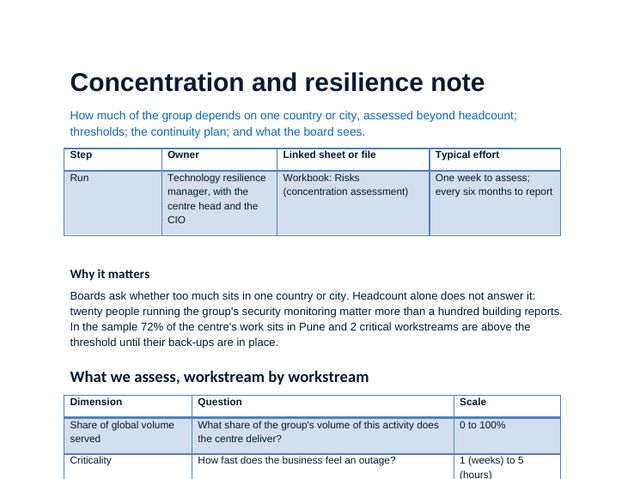
Concentration and resilience note
Concentration assessed beyond headcount, thresholds, scenarios, mitigation by workstream and a board report template.
 PDF
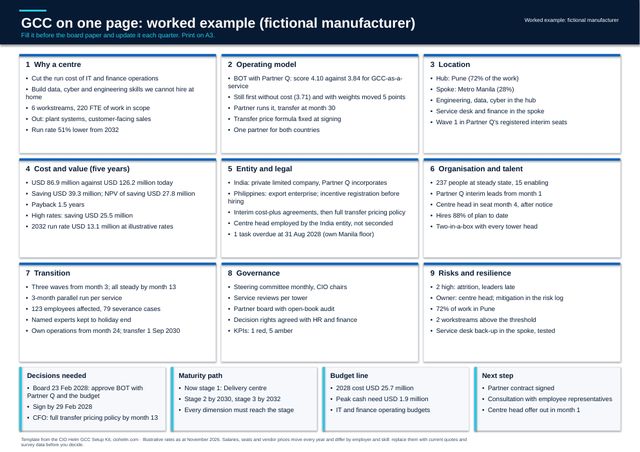
GCC on a page (A3)
The centre on one A3 page: a blank template and a worked example.
 Guide
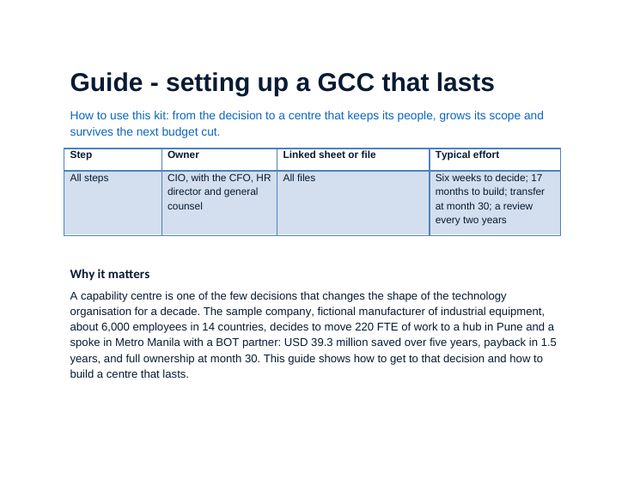
Setting up a GCC that lasts
The method in seven steps, the worked example in numbers, the questions the board will ask and what makes a centre last.
GCC setup workbook, sheet by sheet
The workbook carries the method: scores, choices and plans calculate as you type, and the dashboard and deck figures come from it. Click any image to see it full size.
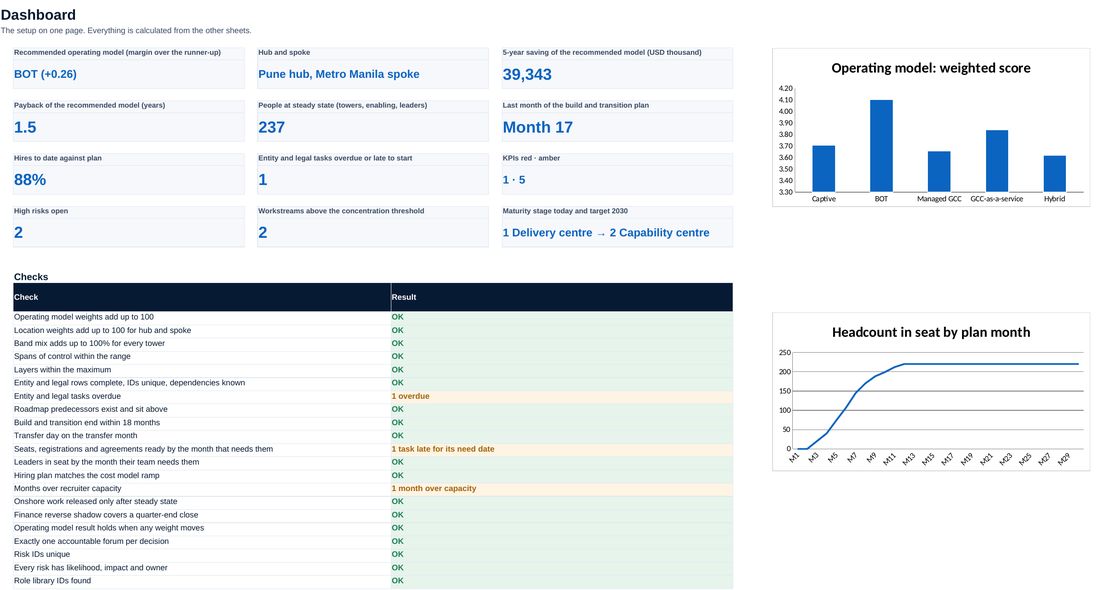
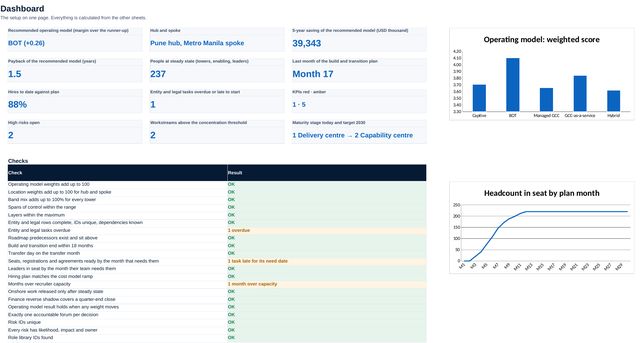
The recommended model and its margin, hub and spoke, five-year saving and payback, headcount, hires against plan, entity tasks, KPIs, risks, concentration and maturity, with the checks, on one page.
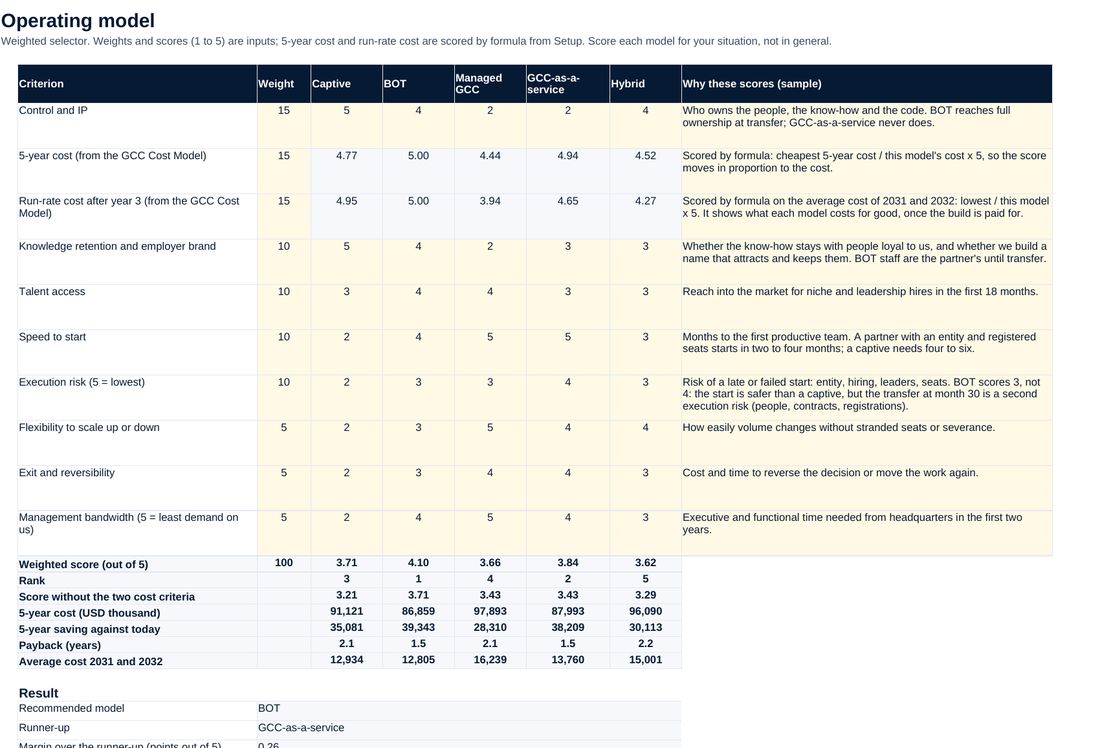
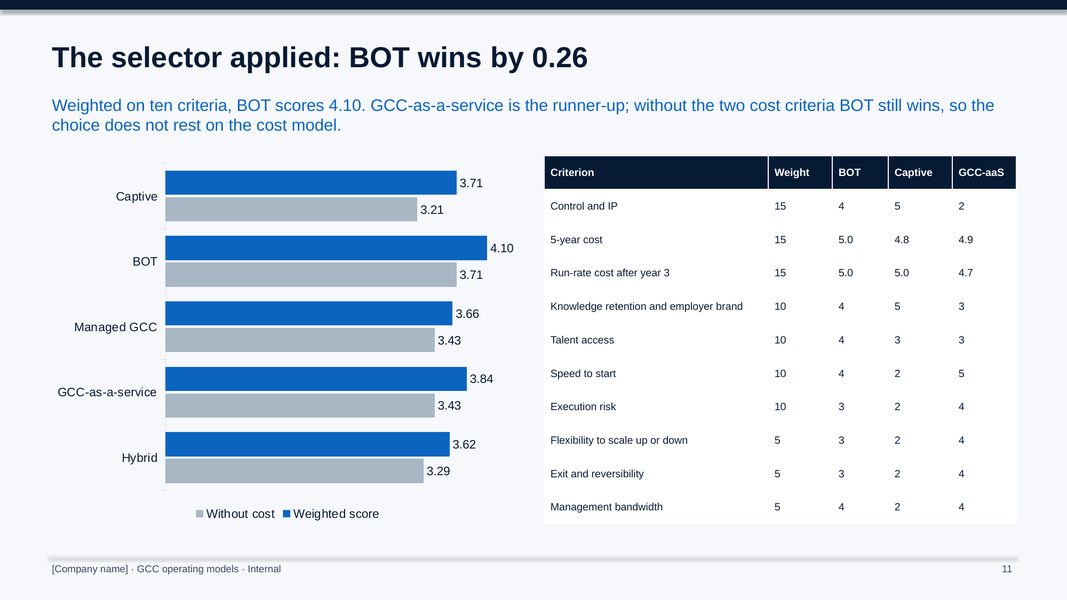
Captive, BOT, managed GCC, GCC-as-a-service and hybrid scored on ten weighted criteria, with the five-year and run-rate cost from the GCC Cost Model, the margin to the runner-up, the result without cost, a weight test and the decision tree per workstream.
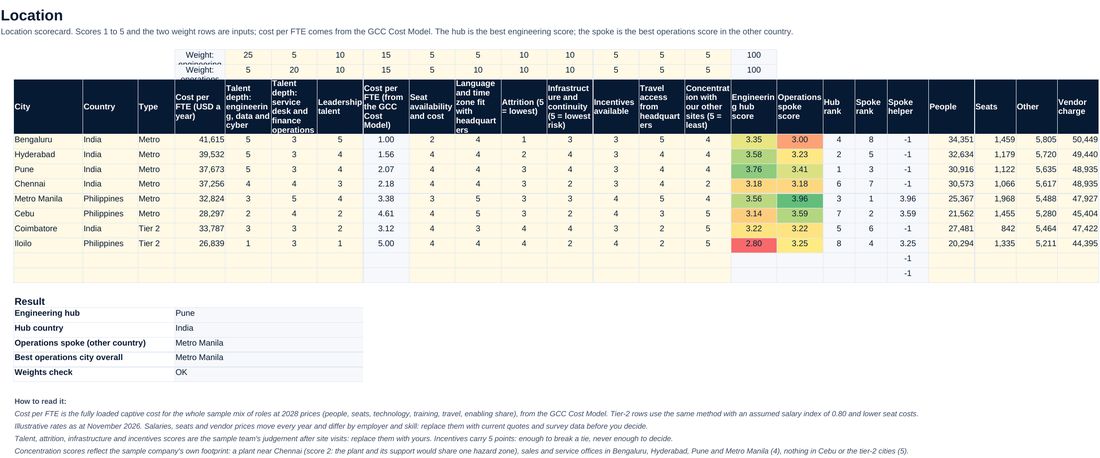
Six cities and two tier-2 options scored for an engineering hub and an operations spoke, with cost per FTE, talent, attrition, continuity and incentives.
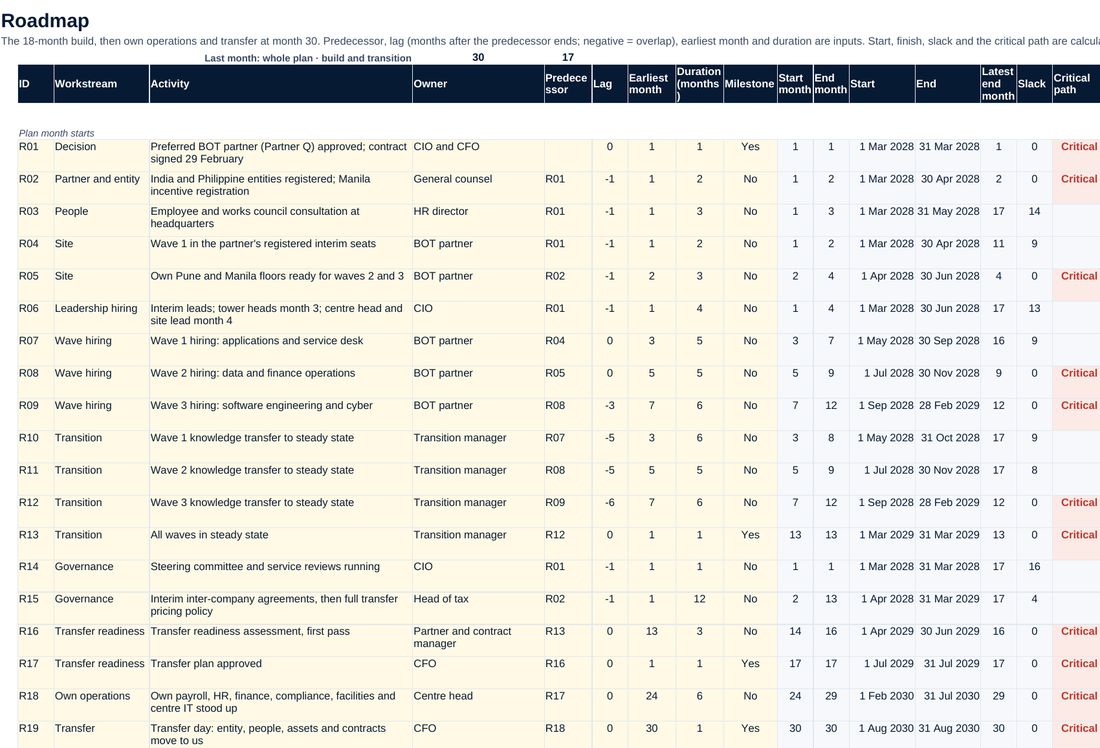
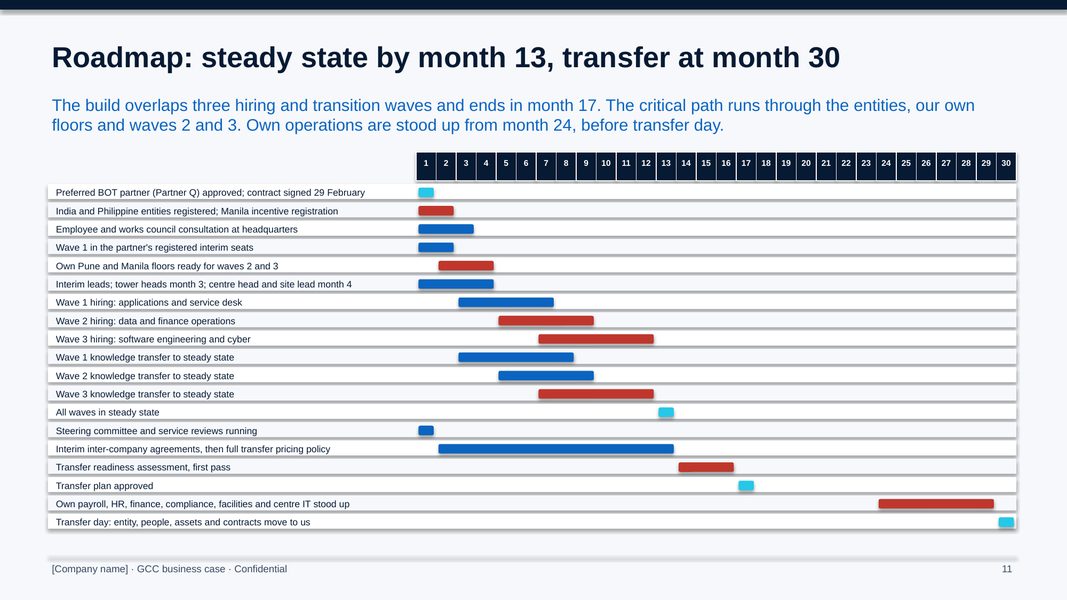
Nineteen activities over 30 months with dates computed from the start date, predecessors, a monthly Gantt, milestones and the critical path.
Screenshots of the workbook with its sample data, opened in a spreadsheet application.
A centre that is built to last, not just to save
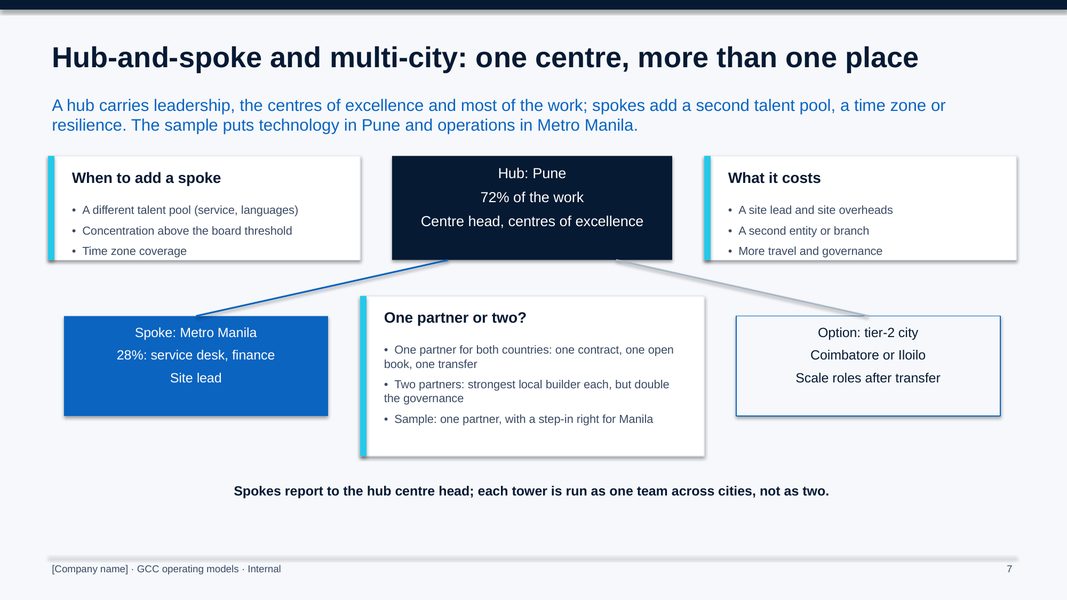
The sample manufacturer moves 220 FTE of IT and finance work in six workstreams. BOT scores 4.10 against 3.84 for GCC-as-a-service, and still wins with cost taken out (3.71) and when any weight moves by 5 points. It costs USD 86.9 million over five years against USD 126.2 million today, saves USD 39.3 million and pays back in 1.5 years; with High rates it still saves USD 25.5 million. Pune is the hub with 72% of the work and Metro Manila the spoke for the service desk and finance. The partner's interim leads start in month 1 and the centre head in month 4, three waves start from month 3 in the partner's registered seats, all reach steady state by month 13, and the centre runs its own operations from month 24 before the transfer at month 30, with 237 people. 123 onshore employees are affected and 44 of them are redeployed or leave naturally. At the end of August the dashboard shows hires at 88% of plan, one entity task late and two high risks, attrition and late leaders.
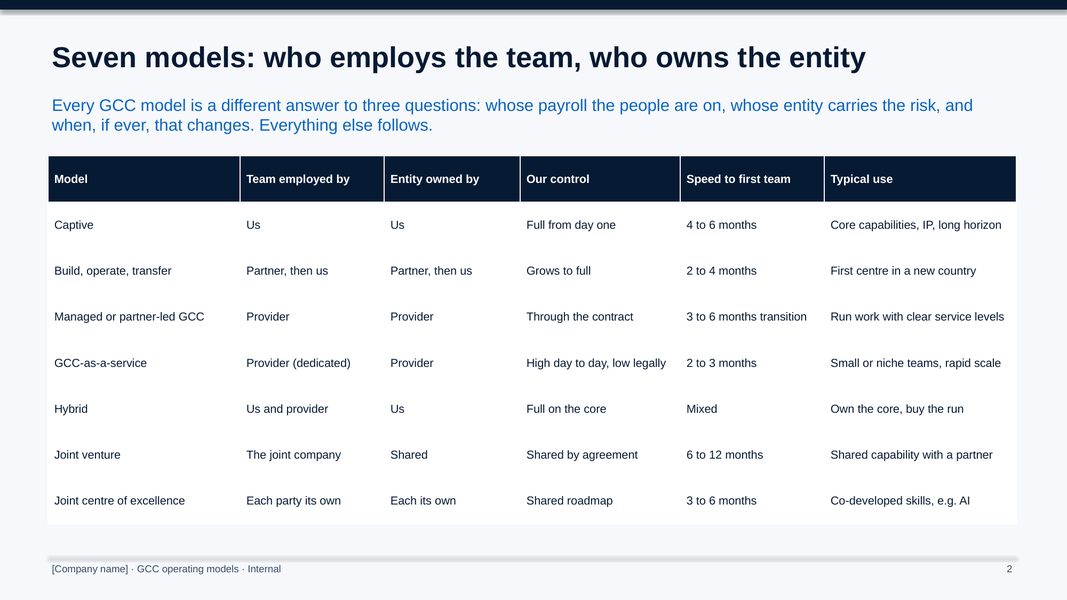
All figures shown are sample data.
The method, step by step
Score the operating models and the cities, take the five-year cost from the GCC Cost Model and take the business case to the executive committee and the board.
Sign the partner, register, start in interim seats, consult employee representatives and put leaders in seat before their teams.
Hire wave by wave inside recruiter capacity, transfer knowledge with entry and exit criteria, stand up own operations and take the centre over.
Track KPIs, risks and concentration, report to the board and move the centre up the maturity stages.
Who it is for
- CIOs and CFOs deciding whether and how to build a capability centre
- COOs and heads of shared services moving IT or finance operations offshore
- Centre heads and programme leads setting up a new centre in India or the Philippines
- Advisers supporting a GCC decision or setup (one licence per client organisation)
What you need
Excel, PowerPoint and Word, or compatible software. The GCC Cost Model (free) for your own five-year cost. Filling the kit for your case takes two to three weeks; the entity and legal steps need local counsel and tax advisers.
Free guides on this topic
Questions about the kit
How is it different from the GCC Cost Model?
The cost model prices the options. This kit decides the operating model and location on more than cost, then plans and runs the setup: entity, roadmap, organisation, hiring, transition, governance and risk.
Does it cover countries other than India and the Philippines?
The method, the selector, the roadmap and the organisation work anywhere. The entity, legal and tax checklist and the city data cover India and the Philippines only.
Are the legal and tax facts current?
They are dated November 2026 and flagged throughout. Laws, rules and incentives change: confirm every point with local counsel and tax advisers before you act.
Is the company in the example real?
No. The manufacturer, the partner and the figures are fictional, and the rates are illustrative. Replace them with your own.
How do I get it?
Checkout is run by Creem, our reseller and merchant of record, which also handles tax and your invoice. As soon as the payment is confirmed we email you a private link to download the kit. Not what you expected? Ask within 14 days for a full refund.
Is it legal or financial advice?
No. The templates are practical starting points for management decisions. Have policies and contracts reviewed against the law that applies to your company.
Who can use it?
You and your colleagues, inside your own organisation. Advisers need one licence per client organisation. Please do not resell or republish it.