Solution Selection Kit
Most regretted technology choices were made early: a vague need, a favourite vendor, criteria set after the answers arrived, and a price that left out half the cost. This kit gives you one fair, defensible way to choose: five stages, five gates, scoring rules fixed before the market answers, and every template you need, filled in for a worked example.
$149 $75 one-time, no subscription
Excel, PowerPoint and Word files. Yours to use and adapt inside your organisation. Delivered by email at once; 14-day refund promise.
19 working files, not a slide pack to read
Every file is editable and comes with a worked example for one fictional company, so you start from something, not from a blank page. Workbooks calculate as you type.
 Excel
Solution selection workbook
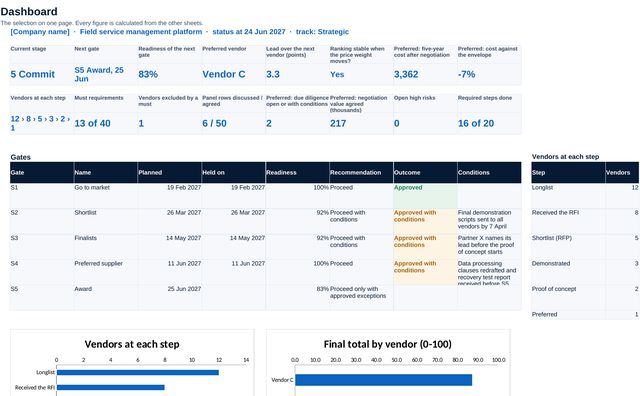
22 sheets that run one selection: track and steps, plan and gates with a calculated recommendation, team and declarations of interest, requirements, the evaluation model with anchored scales, longlist and knock-out tests, RFI scoring, requirement responses and knock-outs, panel scores with calibration, demonstrations, proof of concept, references, due diligence, five-year cost, negotiation, the ranking at each step with a sensitivity test, risks and the decision log. A dashboard pulls it together.
 Excel
Vendor response workbook (RFP)
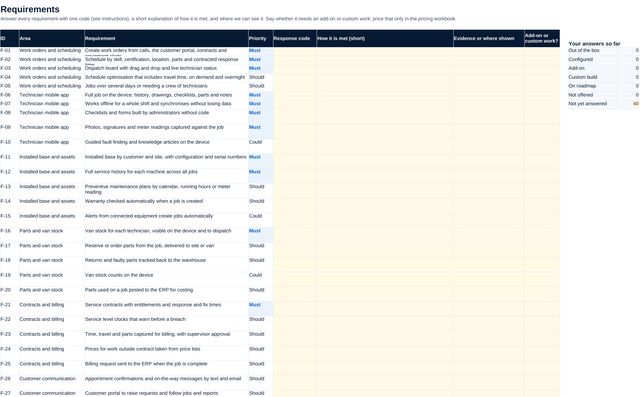
The file every shortlisted vendor answers: instructions, context, 40 requirements with response codes, technology, implementation and company questions, references, questions and the declaration. It contains no prices.
 Excel
Vendor pricing workbook (sealed)
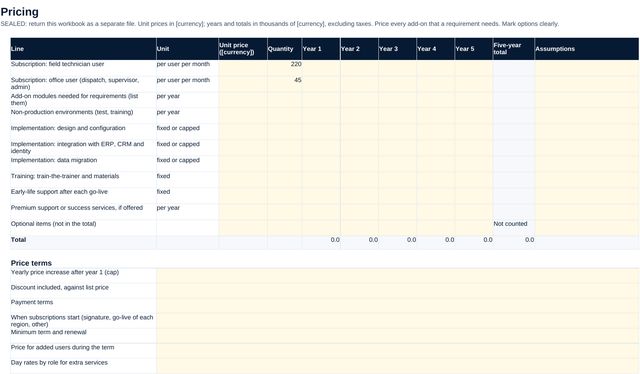
The separate price file each vendor returns sealed: subscriptions, add-ons, implementation, training and support over five years, with the price terms and assumptions behind them. It is opened only after quality is scored.
 PowerPoint
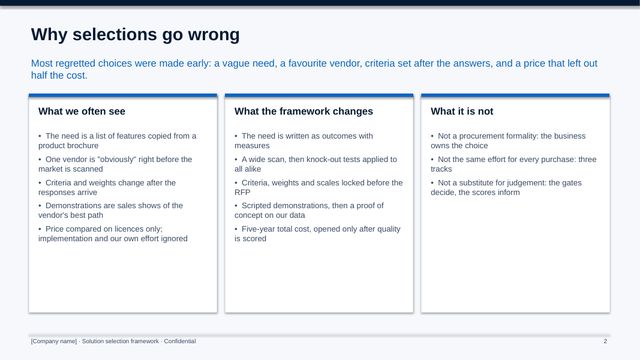
Selection framework overview
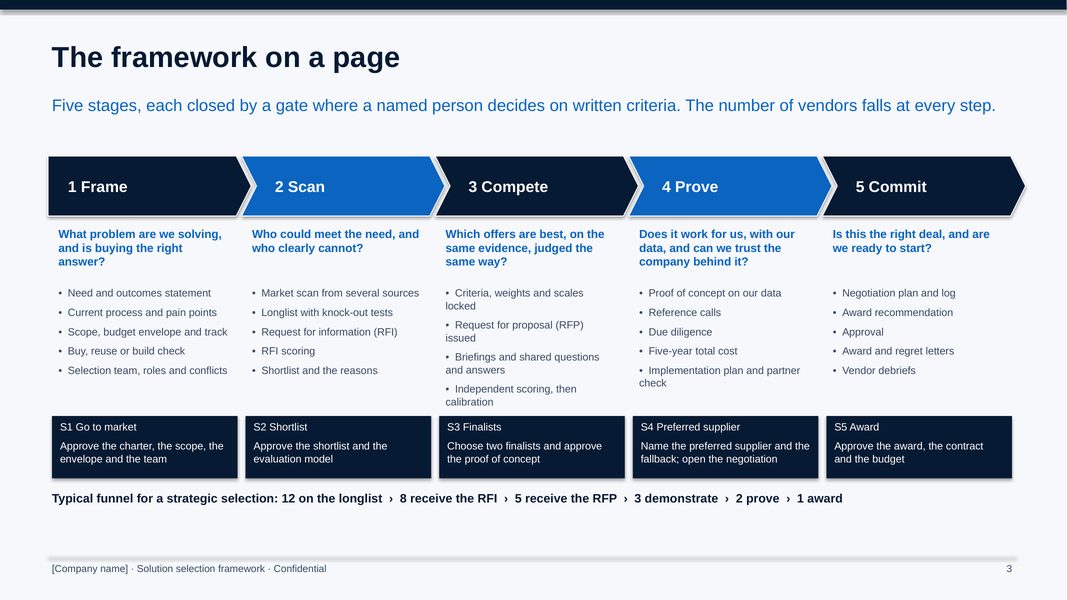
15 slides to get the method adopted: the framework on a page, eight principles, the stages, gates, scoring model, response codes, three tracks, roles and timeline.
 PowerPoint
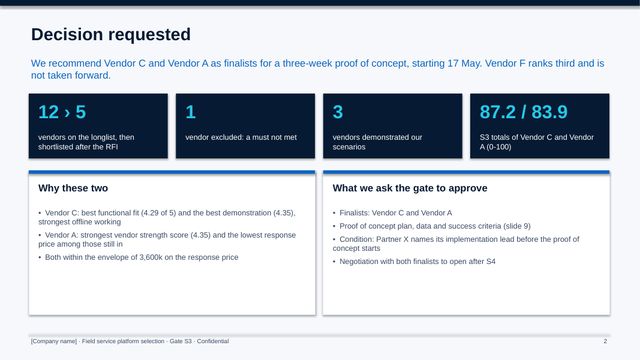
Evaluation results and finalists
10 slides for gate S3, worked through: the funnel, functional fit, panel scores, written ranking, demonstrations and the proof of concept plan.
 PowerPoint
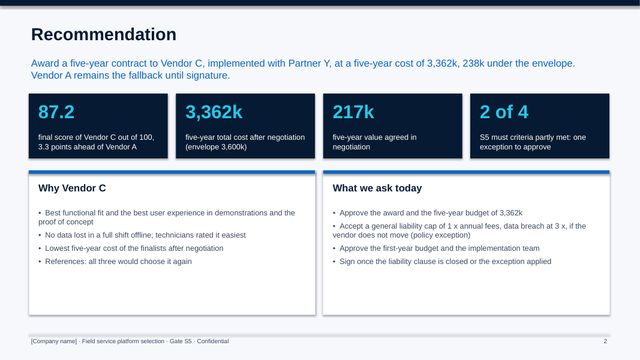
Award recommendation
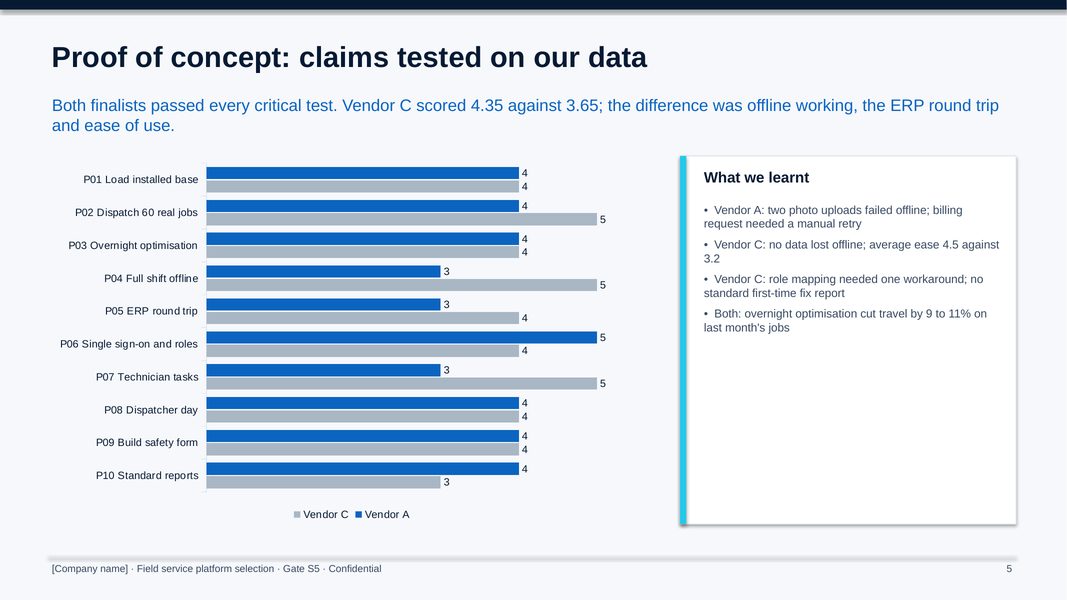
11 slides for the award decision: recommendation, process safeguards, final ranking and sensitivity, proof of concept, references and due diligence, five-year cost, negotiation and risks.
 PowerPoint
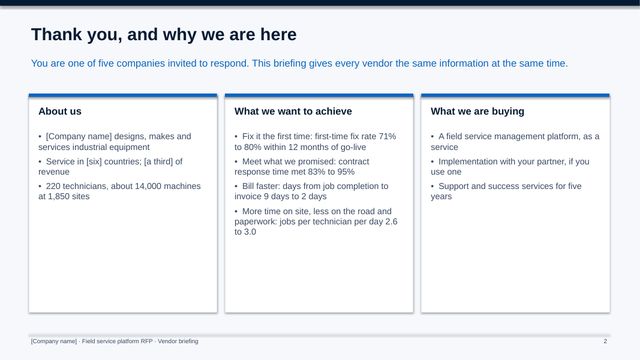
Vendor briefing deck
8 slides to brief every vendor at once: scope, dates, published weights, rules of engagement and what to send.
 Word
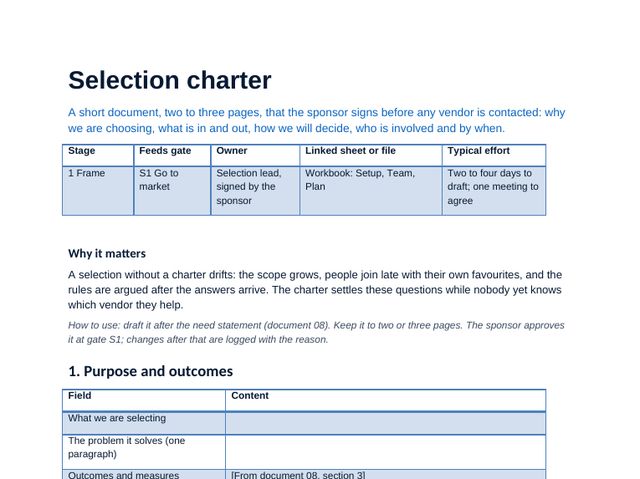
Selection charter
Purpose, scope, envelope, track, principles, team, gates and the declaration of interests.
 Word
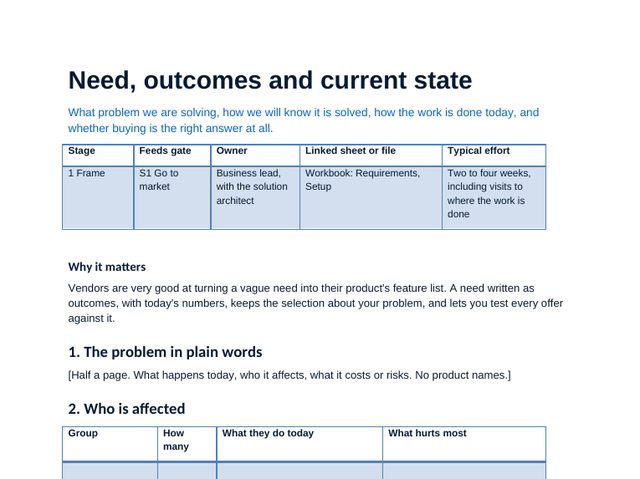
Need, outcomes and current state
The need as outcomes with baselines, the work as it is done today, and the buy, reuse or build check.
 Word
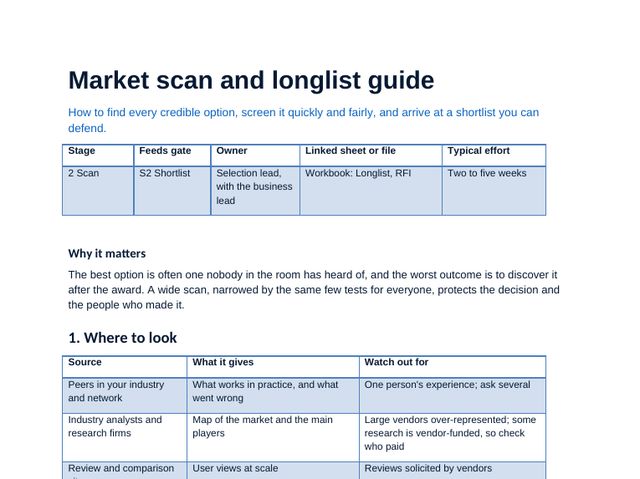
Market scan and longlist guide
Where to look, knock-out tests, the RFI and how to choose a shortlist you can defend.
 Word
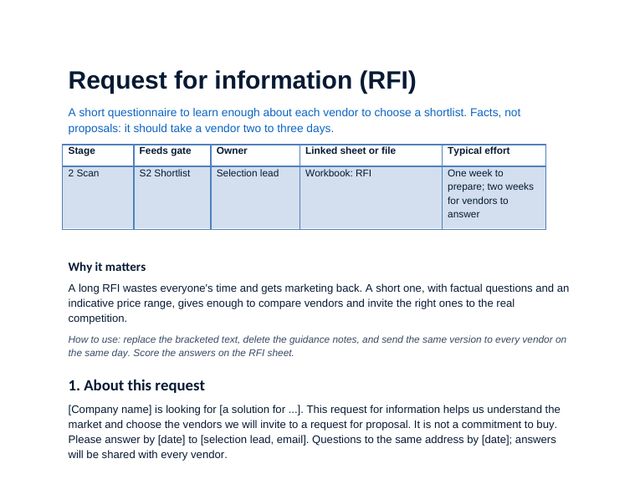
Request for information (RFI)
A short questionnaire vendors can answer in two to three days, with its scoring criteria.
 Word
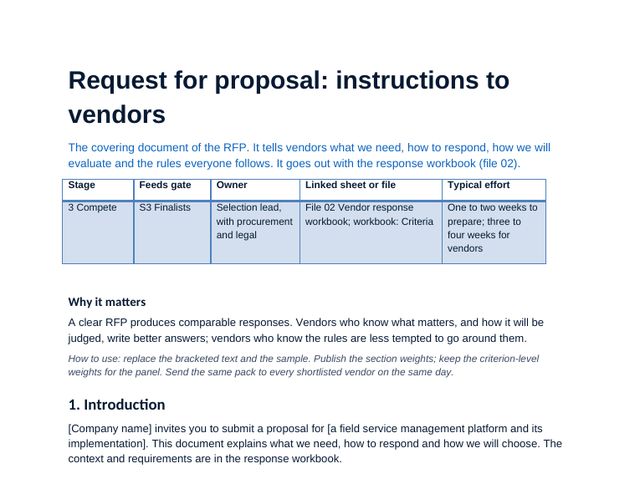
RFP instructions to vendors
Outcomes, timetable, what to submit, published weights, rules of engagement and commercial terms.
 Word
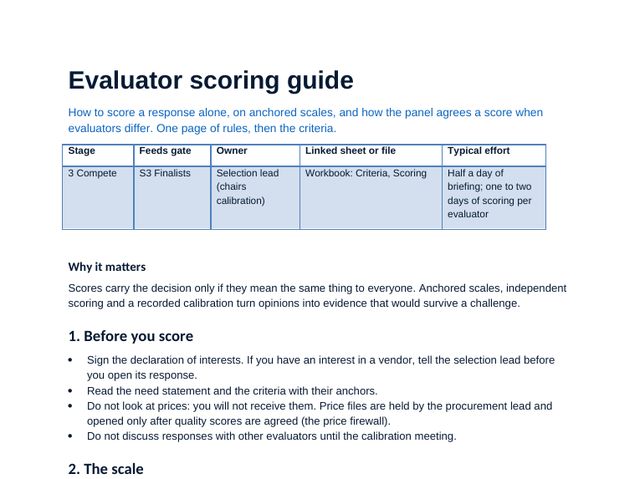
Evaluator scoring guide
Anchored scales for every criterion, how to score alone and how the panel calibrates.
 Word
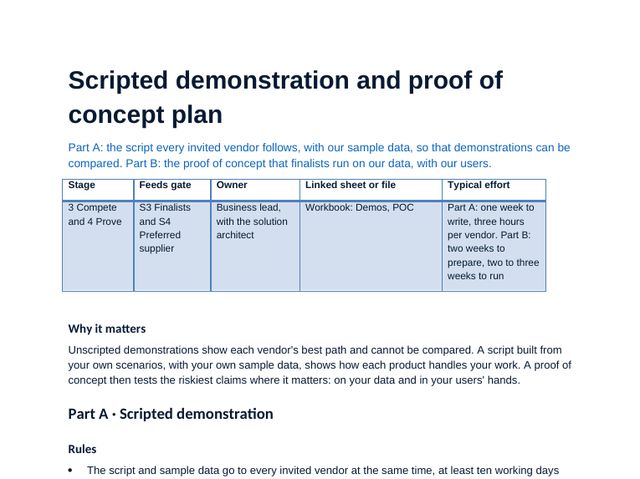
Demo script and proof of concept plan
Scripted scenarios with sample data, then the proof of concept tests, critical tests and results.
 Word
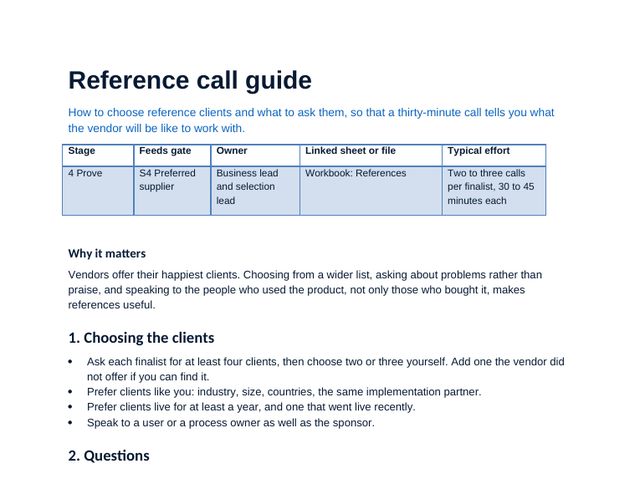
Reference call guide
How to choose reference clients and the questions that reveal problems, with scoring.
 Word
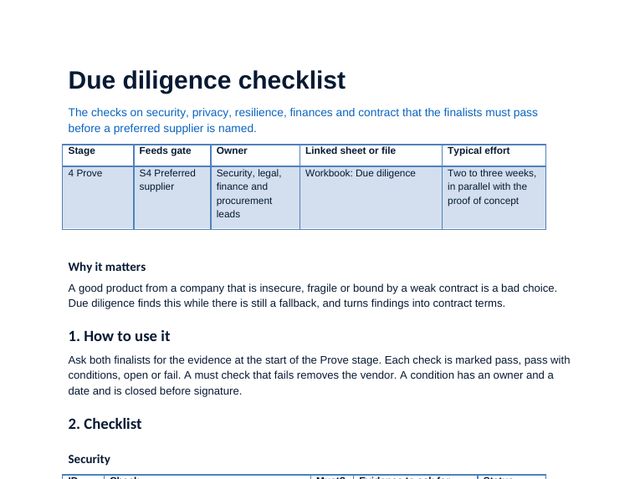
Due diligence checklist
Security, privacy, resilience, financial and contract checks, with the evidence to ask for.
 Word
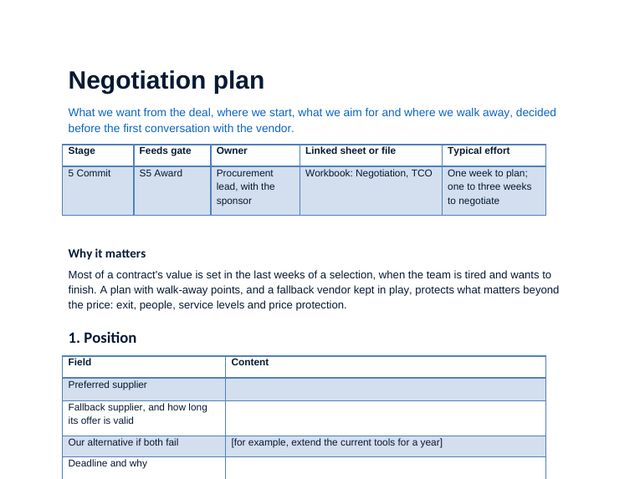
Negotiation plan
Position, fallback, and every term with its opening ask, target and walk-away.
 Word
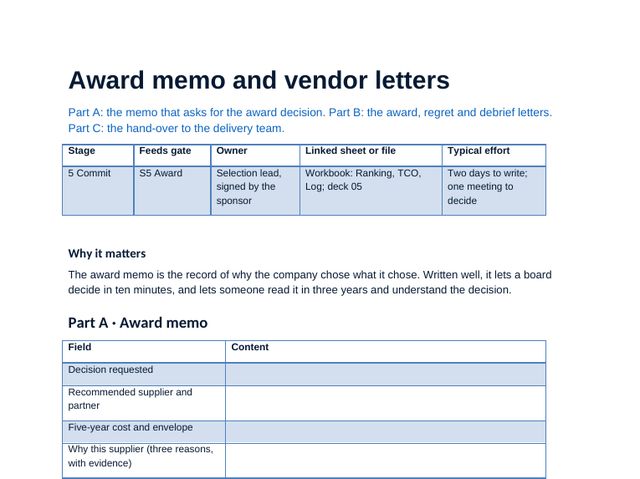
Award memo and vendor letters
The award memo, award and regret letters, debriefs and the hand-over to delivery.
 Guide
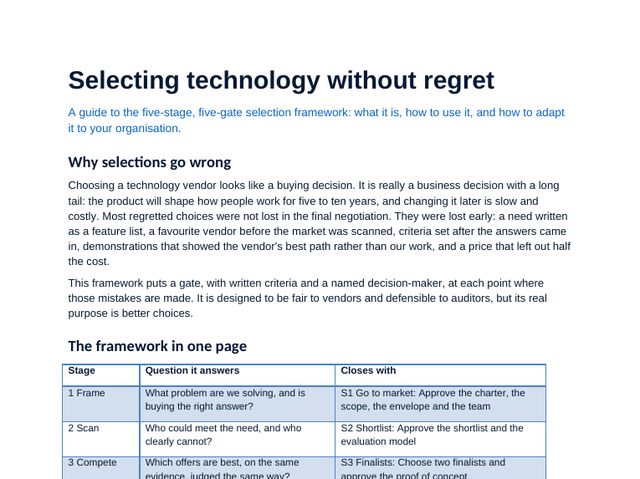
Selecting technology without regret
How to use the method, scale it, score fairly and avoid the common mistakes.
Solution selection workbook, sheet by sheet
The workbook carries the method: scores, choices and plans calculate as you type, and the dashboard and deck figures come from it. Click any image to see it full size.
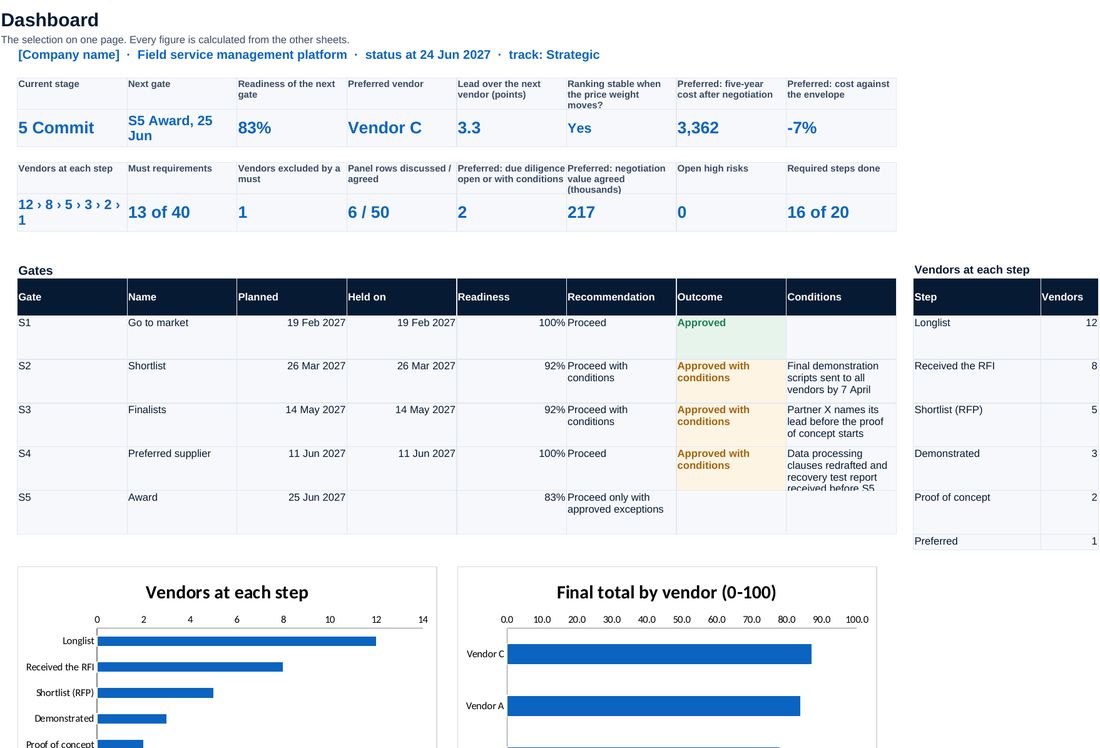
Stage, next gate, preferred vendor, its lead and cost against the envelope, and the funnel.
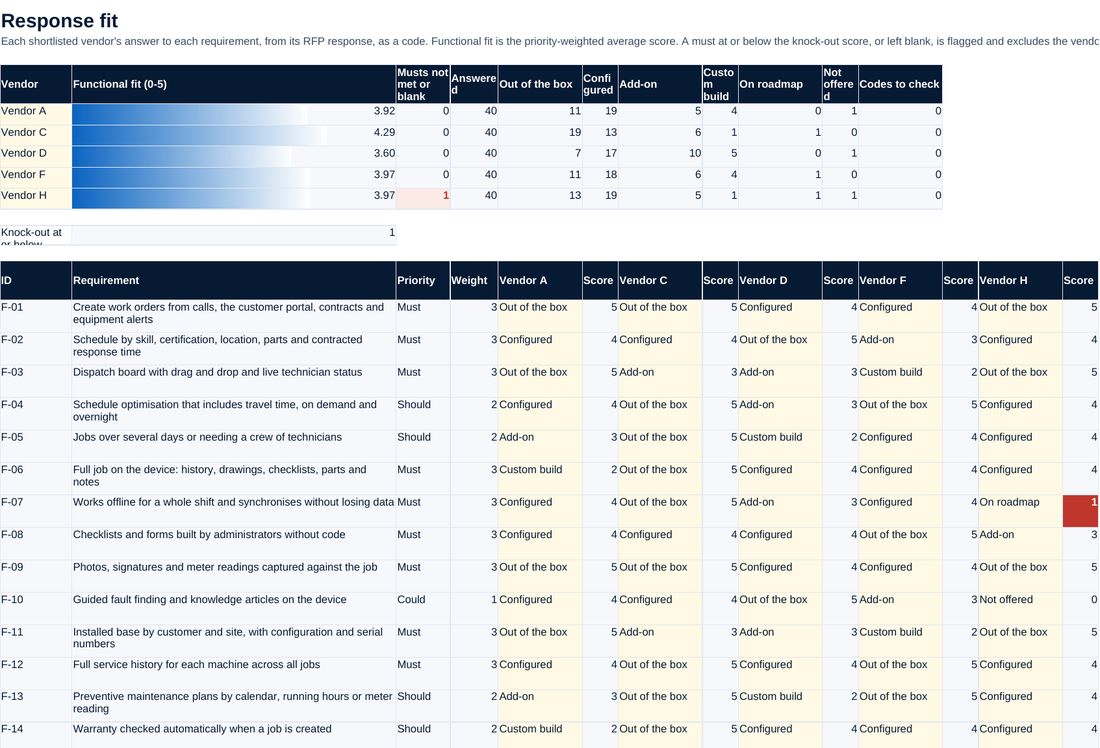
Each vendor's answer to every requirement, the weighted fit and the knock-outs.
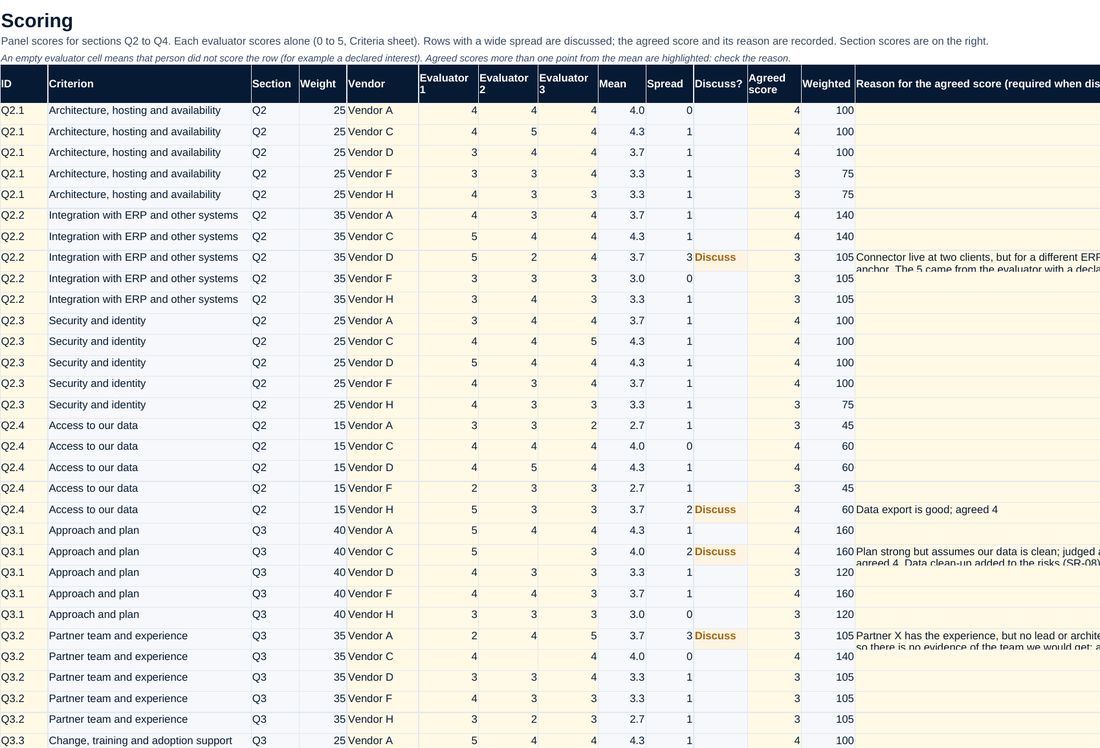
Panel scores by evaluator, spreads to discuss and the agreed score with its reason.
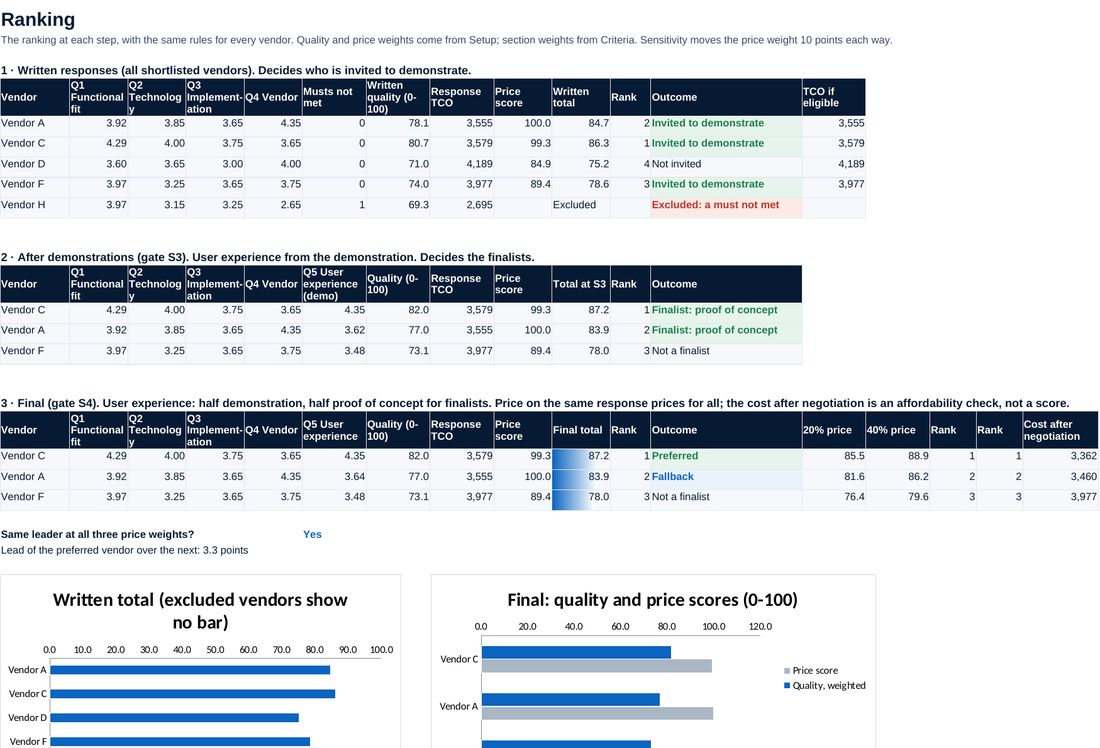
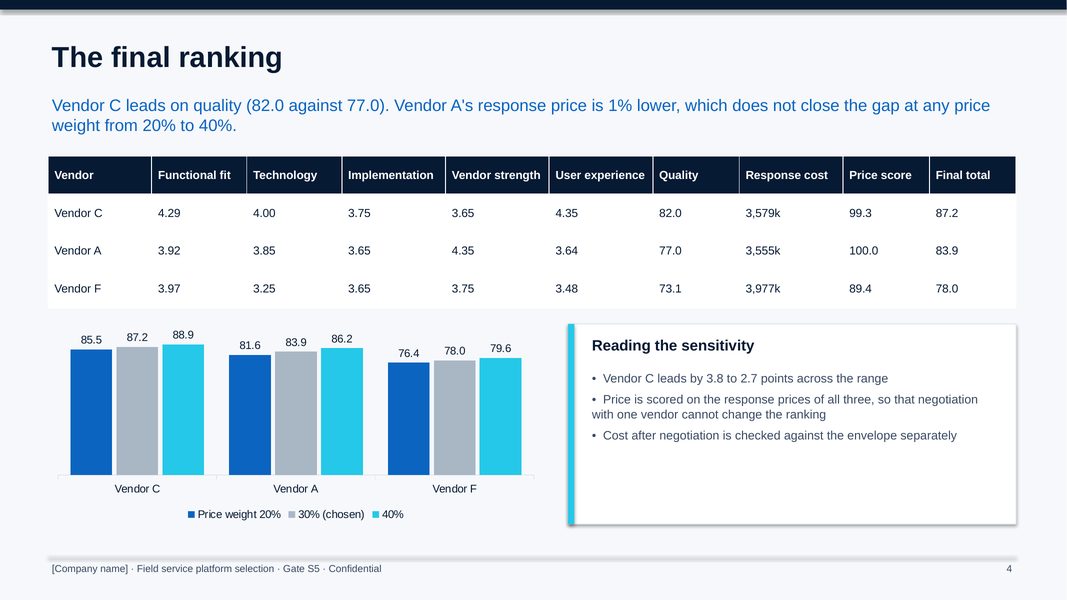
The ranking after written responses, demonstrations and the proof of concept, with sensitivity.
Screenshots of the workbook with its sample data, opened in a spreadsheet application.
A ranking that would survive a challenge
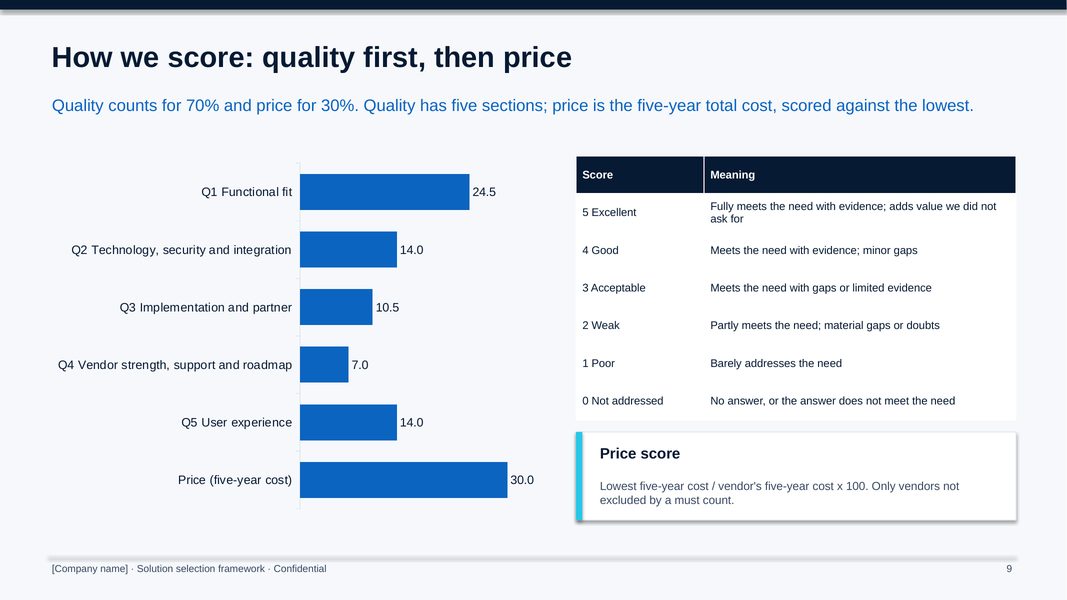
Criteria and weights are locked before the RFP. A must answered "on roadmap" excludes a vendor, even the cheapest. Panels score alone, then agree, and the reason is recorded. Price is opened after quality, scored on five-year cost, and the ranking is tested against the price weight. In the sample, twelve vendors become one award, and every step shows why.
All figures shown are sample data.
The method, step by step
Write the need as outcomes, check reuse, agree the envelope and the track, name the team.
Scan the market wide, apply knock-out tests, run a short RFI, choose the shortlist and lock the criteria.
RFP, independent scoring, scripted demonstrations, then a proof of concept, references and due diligence.
Negotiate with two finalists, write the award memo, award, debrief and hand over to delivery.
Who it is for
- CIOs and heads of IT about to choose a platform, a SaaS product or an implementation partner
- IT sourcing and procurement leads who want business and technical rigour in the process
- Business owners leading a selection with IT
- Advisers running a selection for a client (one licence per client organisation)
What you need
Excel, PowerPoint and Word, or compatible software. A light selection takes four to eight weeks; a strategic one four to six months.
Free guide on this topic
Questions about the kit
Does it replace our procurement policy?
No. It adds the business and technical rigour that most policies assume but do not describe. If you are bound by public procurement law, follow it first; the principles here are consistent with it.
Is it too heavy for a small purchase?
No. Choose the light track and the workbook shows the steps you need: no RFI, a short RFP or quote request, demonstrations and references. The gates and principles stay the same.
Can we use our own criteria and weights?
Yes. Sections, criteria, weights, scales, response codes and the quality and price split are all set on the Criteria and Setup sheets. Lock them before the RFP goes out.
Are the vendors in the example real?
No. Vendor A to L and Partner X, Y and Z are fictional, as is the manufacturer. Replace them with your own.
How do I get it?
Checkout is run by Creem, our reseller and merchant of record, which also handles tax and your invoice. As soon as the payment is confirmed we email you a private link to download the kit. Not what you expected? Ask within 14 days for a full refund.
Is it legal or financial advice?
No. The templates are practical starting points for management decisions. Have policies and contracts reviewed against the law that applies to your company.
Who can use it?
You and your colleagues, inside your own organisation. Advisers need one licence per client organisation. Please do not resell or republish it.